Untapped 340B Savings Through Better Drug Pricing and Compliance
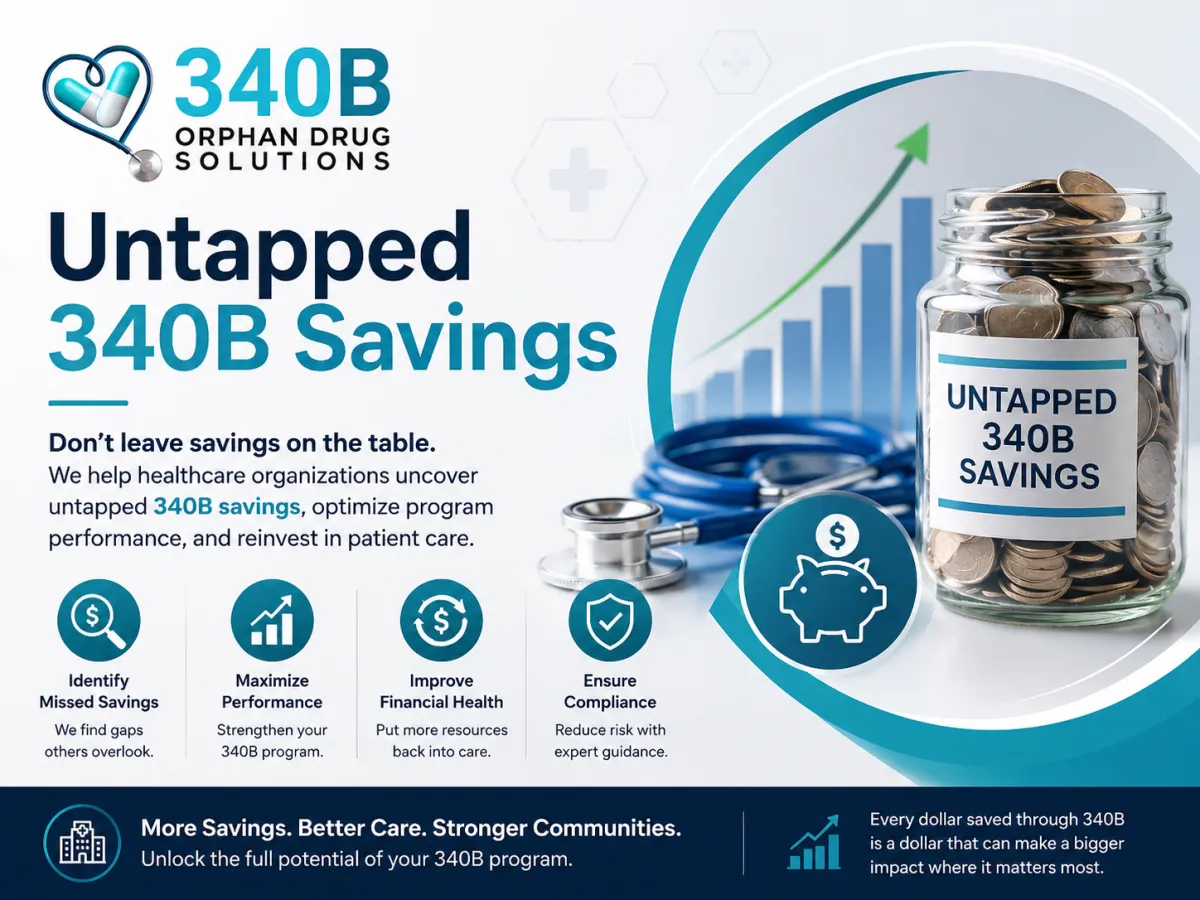
Most hospitals capture some of their 340B savings. Very few capture all of it. The gap between the two is what we call untapped 340B savings.
The savings usually hide in orphan drug pricing that changed without notice. It also hides in a contract pharmacy that never got reconciled. Another reason for revenue loss is a split billing rule that quietly misfired for months.
None of the aforementioned reasons are reflected on a typical monthly report. Purchasing looks normal, dispensing looks normal, and the only sign something is wrong is a savings number that feels a little lower than it should given your patient volume. That is exactly why so much of this money goes unnoticed for years at a time.
As an owner or stakeholder of a 340B compliant healthcare entity, you should know where the money tends to go. Also, you should understand why it happens and what a realistic recovery process looks like.
What Are Untapped 340B Savings?
Untapped 340B savings are discounts your hospital is legally entitled to but is not actually capturing. This missed opportunity can be attributed to either of the following:
A 340B eligible claim that got billed at standard price
An orphan drug discount a manufacturer quietly withdrew
A contract pharmacy location that was never fully reconciled against your purchasing records.
None of these show up as an error message. They show up as a smaller number on your savings report than your patient volume and drug mix should produce.
The tricky part is that untapped savings rarely announce themselves. A hospital can be fully compliant and still be leaving money behind. It can be because nobody is checking the gap between what the program allows and what the hospital is actually collecting.
Compliance and optimization are two different jobs. A program can pass every audit and still be underperforming financially. This happens because audits check whether you followed the rules, not whether you captured every dollar the rules allow.
Given that manufacturers provided tens of billions of dollars in 340B discounts to hospitals in a single recent year, even a small percentage gap across a health system's full drug spend can translate into a meaningful, recoverable number.
Untapped 340B Savings Opportunities
These are the opportunity areas where 340B Orphan Drug Solutions most often finds savings hospitals did not know they were missing.
| Opportunity Area | What Gets Missed |
|---|---|
| Orphan drug discretionary pricing | Manufacturer discounts that change quarterly and go untracked. |
| Contract pharmacy expansion | Eligible dispensing locations never registered or reconciled. |
| Drug mix review | High cost specialty and orphan drugs not flagged for priority tracking. |
| Split billing accuracy | Misconfigured software routing 340B eligible claims at standard price. |
| GPO exclusion compliance | DSH, children's, and cancer hospitals accidentally using GPO purchasing where prohibited. |
Orphan drug pricing tends to be the single largest opportunity on this list. It is simply because the discount is discretionary rather than guaranteed. A hospital with a strong process for tracking every other item on this table can still lose significant money if nobody is watching orphan drug status closely enough.
Common Causes of Lost 340B Savings
Lost savings rarely trace back to one big mistake. They usually trace back to a handful of small, recurring gaps that compound over several quarters before anyone notices the pattern.
Here are the common causes of untapped 340B savings and the reason behind each cause:
| Common Cause | Why It Happens |
|---|---|
| Manual, spreadsheet-based tracking | Quarterly ceiling price and discount changes are easy to miss by hand. |
| Staff turnover | 340B knowledge often lives with one person instead of a documented process. |
| Orphan drug status changes | Manufacturer discretion means a discount can disappear without notice. |
| Inventory misconfiguration | Replenishment models are not reconciled often enough to catch drift. |
| Recertification lapses | Missed annual recertification can quietly suspend program eligibility. |
Individually, each of these looks minor. Together, over a full year, they can add up to a meaningful percentage of a hospital's total 340B savings potential.
Revenue Recovery Opportunities
Once a gap is identified, you should try to leverage missed opportunities. This can be done by opting for recovery paths. Your chosen path depends on how far back the issue goes and what caused it.
Here are the different recovery paths you can opt for:
| S.No. | Recovery Paths |
|---|---|
| 01. | Retrospective claims review to identify eligible dispensations billed at standard price. |
| 02. | Replenishment reconciliation to correct inventory drift between purchasing and dispensing records. |
| 03. | Manufacturer follow-up on orphan drug discount status that changed without proper notice. |
| 04. | Contract pharmacy audits to confirm every registered location is reconciled correctly. |
Recovery windows vary by manufacturer and by the type of error involved. Therefore, the earlier you identify a gap, the more of that money is realistically recoverable.
If you wait until the next annual audit to look for these gaps, you will miss an entire year of savings, which goes unclaimed before anyone even starts looking.
Hospital Savings Optimization Strategies
You can maximize 340B savings by building a few habits into your program. This is essential instead of treating pharmacy optimization as a once-a-year project. Hospitals that treat this as continuous, rather than reactive, consistently outperform those that only look closely right before an audit.
Here are the key hospital savings optimization strategies that you can deploy to optimize the missed opportunities:
| S.No. | Strategies |
|---|---|
| 01. | Run self-audits monthly, or quarterly at minimum, on a sample of dispensations. |
| 02. | Review orphan drug discretionary status every quarter, drug by drug. |
| 03. | Reconcile every contract pharmacy location against purchasing records monthly. |
| 04. | Confirm annual recertification is filed well before the deadline. |
| 05. | Centralize documentation so audit preparation never starts from zero. |
Areas for 340B Cost Improvement
Beyond audits, a few structural changes tend to produce the largest hospital savings opportunities over time. These are the improvements that shift a program from reactive to proactive.
| Cost Improvement Area | Recommended Action |
|---|---|
| Ceiling price tracking | Move from manual review to a system that flags quarterly AMP and URA changes. |
| Orphan drug monitoring | Review manufacturer discretionary status drug by drug every quarter. |
| Contract pharmacy oversight | Reconcile dispensing data monthly across every registered location. |
| Compliance documentation | Centralize audit records so they are ready for review at any time. |
| Staff training | Refresh 340B training on a recurring schedule, not a one-time basis. |
None of these changes require ripping out your existing systems. Most hospitals get the biggest lift simply by adding a dedicated review cycle around orphan drugs and contract pharmacies, the two areas where savings tend to erode fastest without anyone noticing.
Frequently Asked Questions
Q1. What are untapped 340B savings?
Untapped 340B savings are discounts a covered entity is eligible for but is not actually capturing. It is often due to an inability to track gaps, missed orphan drug discount changes, or split billing errors that go unnoticed.
Q2. Why do hospitals miss 340B savings?
Most misses trace back to manual tracking, staff turnover, unreviewed orphan drug discount changes, or inventory reconciliation that does not happen often enough to catch drift before it adds up. Smaller hospitals feel this most, since one person is often responsible for a job that really needs continuous, dedicated attention.
Q3. What is the average discount for 340B?
HRSA and industry groups, such as the American Hospital Association and National Pharmaceutical Council, estimate average 340B savings between 25 and 50 percent. This number is for brand-name drugs. Whereas generic drugs are typically discounted 10 to 25 percent.
Q4. How often should 340B audits occur?
HRSA guidance points to monthly self-audits of a sample of dispensations, or quarterly at minimum. Also. annual independent audits of contract pharmacy arrangements are necessary. HRSA itself randomly audits roughly 200 covered entities a year.
Q5. Why does 340B exist?
Congress created the program through the Veterans Health Care Act of 1992. The law was enacted to cover entities that could stretch scarce federal resources further. The goal was to help covered entities reach more eligible patients with the savings generated on outpatient drug purchases.
Q6. How much can hospitals save with the 340B Program?
According to the American Hospital Association, industry-wide, drug manufacturers provided an estimated 46.5 billion dollars in 340B discounts to hospitals in 2022 alone. An individual hospital's savings depend on patient volume, drug mix, and how consistently orphan drug discounts are tracked.
Curious how much of your 340B savings might be going untapped?
Request a savings review from 340B Orphan Drug Solutions and get a clear picture of where your hospital may be leaving hidden drug savings on the table.
Disclaimer
This content is provided for general informational purposes only and does not constitute legal, regulatory, reimbursement, or financial advice. All savings figures, examples, and calculations on this page are illustrative estimates, not guarantees. Actual 340B and orphan drug savings vary based on manufacturer pricing decisions, patient population, drug mix, and 340B compliance status. Covered entities should confirm current requirements directly with HRSA's Office of Pharmacy Affairs and consult qualified counsel before making compliance or purchasing decisions.
Maximizing savings. Ensuring compliance. Advancing access to life-changing therapies.


© 2026 340B Orphan Drug Solutions. All rights reserved.