Understanding Section 340B Program for Covered Entities
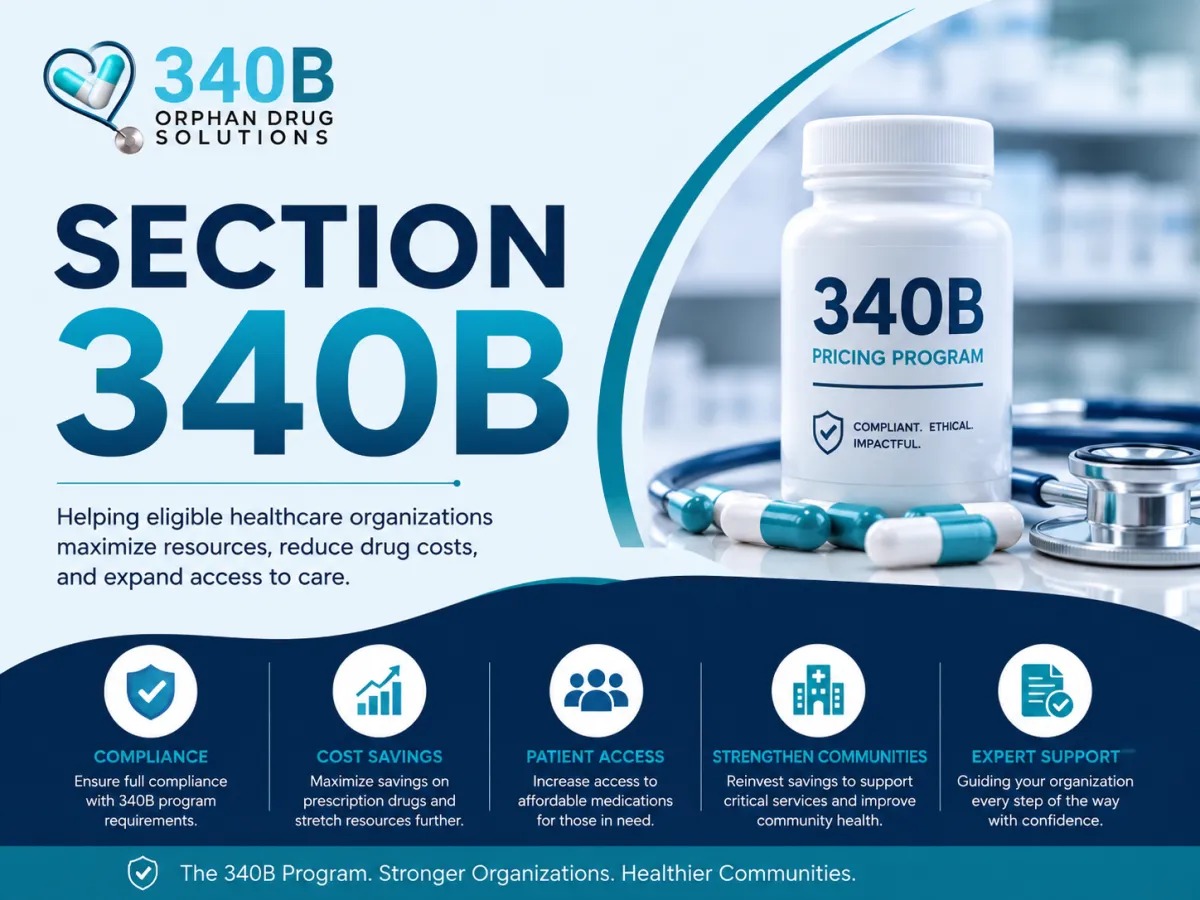
Section 340B can protect your hospital's margin or quietly cost you hundreds of thousands of dollars a year. The difference comes down to how well your team tracks eligibility, pricing, and orphan drug rules. 340B Orphan Drug Solutions helps covered entities capture every dollar they are owed under the Section 340B program, without missing a compliance requirement along the way.
If your pharmacy team is buried in manufacturer rule changes and quarterly orphan drug updates, you are not alone. Keep reading to see how the 340B healthcare law works, who qualifies, and how a focused compliance partner can free up dozens of hours a quarter while protecting your savings.
What is Section 340B: Key Highlights
Section 340B is a law covered under the Public Health Service Act. It is officially titled as ‘Limitation on Prices of Drugs Purchased by Covered Entities’. It is codified at 42 U.S.C. 256b under the Act. This law was enacted through Section 602 of the Veterans Health Care Act of 1992, Public Law 102-585.
The US Congress built it around a simple trade, which was: manufacturers get access to Medicaid and Medicare Part B, and in exchange they agree to sell outpatient drugs to safety net providers at a capped price.
The statute does not hand out discounts directly. Instead, it instructs the Health and Human Services (HHS) Secretary to enter into a pharmaceutical pricing agreement (PPA) with each drug manufacturer that wants its outpatient drugs covered under Medicaid and Medicare Part B.
By signing that agreement, a manufacturer commits to charging registered covered entities no more than the 340B ceiling price for covered outpatient drugs. Congress built the law this way so participation in Medicaid becomes the lever that pulls manufacturers into the 340B program.
What is the 340B Ceiling Price?
The ceiling price is calculated by the Health Resources and Services Administration (HRSA) every quarter. The calculation is based on pricing that data manufacturers report to Centers for Medicare & Medicaid Services (CMS). That is why the discount a hospital sees on a given drug can shift from one quarter to the next.
340B Ceiling Price Formula
AMP − URA = 340B Ceiling PriceAMP = Average Manufacturer Price (based on the smallest billable unit of the drug)
URA = Unit Rebate Amount (minimum 23.1% for most brand-name drugs, minimum 13% for generic and over-the-counter drugs)
Lawmakers were explicit about why they wrote the statute this way. The original House report describes the goal as allowing covered entities to stretch scarce federal resources as far as possible, reaching more eligible patients and providing more comprehensive services. HRSA's Office of Pharmacy Affairs, operating under delegated authority from the HHS Secretary, administers the program day to day, from covered entity registration through ceiling price enforcement.
Costs Associated with 340B Sales
As per the Congressional Research Service’s Overview of the 340B Drug Discount Program:
340B purchases account for roughly 7.2 percent of the entire United States drug market
In 2021, total program sales reached close to 44 billion dollars.
A ceiling price violation or diversion finding puts access to a multi-billion dollar program at risk, not just a small administrative fine.
Orphan Drugs
Under Section 340B(e), drugs designated for a rare disease or condition are excluded from mandatory 340B pricing for certain hospital types, unless the manufacturer voluntarily agrees to offer a discount.
That single exception is where most hospitals lose money they never knew they were entitled to capture.
Prime Vendor Program
The 340B healthcare law also created a Prime Vendor Program. The Prime Vendor Program has been run by Apexus since 2004. Owing to this, covered entities can negotiate sub-ceiling prices as a group rather than facing manufacturers alone.
Every hospital in the US is not obligated to join the Prime Vendor Program. However, most hospitals use it because it gives smaller facilities the same negotiating leverage as much larger health systems.
Why the Section 340B Program Matters for Hospitals Like Yours
Every dollar saved through the Section 340B program is a dollar your hospital can put back into direct patient care. For safety net providers operating on thin margins, that difference shows up fast, especially:
In staffing levels
In service lines that stay open
In how many uninsured patients you can afford to treat.
This difference is starkly visible for orphan drugs. This is because:
Rare disease therapies are often the most expensive line items on a specialty pharmacy budget.
Their 340B status depends on manufacturer discretion rather than statute; the rules shift every quarter.
Thus, a hospital that is not actively tracking those changes is very likely leaving discretionary savings unclaimed. This can happen quarter after quarter, without ever knowing it.
340B Covered Entity Eligibility
Section 340B(a)(4) of the Public Health Service Act names the specific 340B covered entities that qualify, and each category falls into one of two groups, which are:
Hospital-based entities
Non-hospital entities
Each healthcare entity has its own eligibility path. As per 340B Drug Pricing Program Eligibility, eligibility is not a one-time event. Covered entities must recertify every year. Also, they must notify HRSA's Office of Pharmacy Affairs the moment their status changes. If a facility loses eligibility, it has to stop purchasing 340B-priced drugs right away.
Eligibility for Hospital-Based Covered Entities
Here are the eligibility criteria for hospital-based entities:
| Hospital-Based Covered Entities | |
|---|---|
| Entity Type | Eligibility Criteria |
| Disproportionate Share Hospitals (DSH) | Must meet Medicare DSH payer mix thresholds |
| Critical Access Hospitals (CAHs) | No DSH payer mix requirement |
| Sole Community Hospitals (SCHs) | Must meet DSH payer mix thresholds |
| Rural Referral Centers (RRCs) | Must meet DSH payer mix thresholds |
| Children's Hospitals | Exempt from DSH payer mix requirement |
| Free Standing Cancer Hospitals | Exempt from DSH payer mix requirement |
Eligibility for Non-Hospital Covered Entities
| Non-Hospital Covered Entities | |
|---|---|
| Entity Type | Eligibility Criteria |
| Federally Qualified Health Centers (FQHCs) and look-alikes | HRSA health center grant funding |
| Ryan White HIV/AIDS program grantees | Ryan White CARE Act funding |
| State AIDS Drug Assistance Programs | State ADAP funding |
| Native Hawaiian Health Centers | Native Hawaiian Health Care Act funding |
| Urban Indian Health Centers | Indian Health Service funding |
| Title X Family Planning Clinics | Title X grant funding |
| Sexually Transmitted Disease Clinics | Federal STD program funding |
| Tuberculosis Clinics | Federal TB program funding |
| Comprehensive Hemophilia Treatment Centers | Federal grant funding |
| Black Lung Clinics | Federal Black Lung program funding |
340B Program Process Overview
Once eligibility is confirmed, participating in the Section 340B program follows a fairly consistent sequence. Each step builds on the preceding one. If you skip any one step, you will start facing compliance problems.
Here are the steps to participate in this program:
| 340B Program Process | What Each Step Entails |
|---|---|
| Step 1: Registration | You need to register your healthcare entity during the quarterly HRSA registration window. With this, you receive a unique 340B identification number. |
| Step 2: Enrollment | Thereafter, you must enroll outpatient facilities and any contract pharmacies that will dispense 340B drugs. |
| Step 3: Purchasing | In the third step, you should purchase covered outpatient drugs at or below the 340B ceiling price through an authorized distributor. |
| Step 4: Tracking | Then, you have to track eligible patient status to prevent diversion of discounted drugs to non-patients. |
| Step 5: Billing | In this step, you should reconcile Medicaid billing to prevent duplicate discounts on the same claim. |
| Step 6: Recertification | You are mandated to apply for certification each year. Also, you must keep the current Office of Pharmacy Affairs Information System (OPAIS) records. |
Orphan Drugs: Additional Layer to 340B Program Process
After following the due course of this process, you need to focus on orphan drugs. These drugs add an extra layer to this process. It is because their 340B pricing depends on manufacturer discretion rather than statute.
Your team has to track discount status drug by drug, every quarter, as manufacturer decisions shift. If you miss one update, you can end up paying full price on a drug that should have been discounted. Or sometimes even worse could happen. You could be purchasing the drug at 340B pricing when a manufacturer has quietly withdrawn its discount.
340B Program Benefits Comparison
The value of the Section 340B program goes well beyond a lower invoice. Here is a quick look at what covered entities typically gain when the program is managed well.
| Program Benefit | What It Means for Your Facility |
|---|---|
| Reduced drug acquisition cost | More budget stays available for staffing, equipment, and patient services. |
| Expanded patient reach | Savings can be reinvested to serve more low-income and uninsured patients. |
| Orphan drug discretionary pricing | Access to manufacturer-offered discounts on rare disease therapies when available. |
| Audit readiness | Organized records reduce risk and shorten preparation time before HRSA or manufacturer audits. |
Section 340B Pricing vs Standard Drug Pricing Comparison
The table below breaks down how 340B pricing differs from standard drug purchasing, including where orphan drugs stand apart from the rest of the formulary.
| Pricing Factor | Section 340B Pricing | Standard Drug Pricing |
|---|---|---|
| Ceiling price basis | Capped at the statutory 340B ceiling price set under the Public Health Service Act. | Set through standard wholesale or negotiated contract rates. |
| Typical discount range | Often 25 to 50 percent below wholesale acquisition cost, depending on the drug. | Little to no discount unless separately negotiated. |
| Eligibility requirement | Limited to registered 340B covered entities and their eligible patients. | Available to any qualified purchaser. |
| Orphan drug treatment | Excluded by statute for certain entity types unless a manufacturer chooses to offer a discount. | No exclusion. Priced under normal commercial terms. |
| Compliance obligation | Requires diversion prevention, duplicate discount prevention, and annual recertification. | Standard purchasing terms apply. No federal 340B reporting. |
340B Compliance Checklist
340B compliance protects your savings once you have them. Your healthcare facility can receive audits from HRSA or directly from a manufacturer, often with little advance notice. As the audits arrive unannounced, the strongest programs stay audit-ready year-round instead of scrambling before a review.
To stay prepared, you can use this checklist as a starting point before your next audit:
| S.No. | Checklist |
|---|---|
| 01. | Ensure that OPAIS records are accurate and updated for every outpatient facility and contract pharmacy. |
| 02. | Annual recertification is complete and documented. |
| 03. | There are written policies to prevent diversion of 340B drugs to ineligible patients. |
| 04. | Your Medicaid Exclusion File is current, and the billing method is clearly documented. |
| 05. | The billing method is documented. |
| 06. | Your team reviews orphan drug designations quarterly against FDA and manufacturer updates. |
| 07. | Split billing software at your healthcare facility is configured to flag 340B eligible claims correctly. |
| 08. | Audit files are organized and ready for HRSA or manufacturer review at any time. |
Why Hospitals Choose 340B Orphan Drug Solutions
Dr. Lisa Nezneski, PharmD, BCPS, has spent more than 40 years in healthcare. In the last 11-plus years, she focused exclusively on 340B orphan drugs. Her work has helped hospitals capture over 500 million dollars in orphan drug savings by tracking manufacturer discretionary pricing as it changes, often week to week.
Every engagement is built around your facility. That means your existing workflows, your split billing system, and your team's bandwidth, not a one-size-fits-all template. We offer:
Automated tracking of orphan drug designations and manufacturer discount changes
Custom quarterly reports built for your existing pharmacy and finance workflows
Direct integration support for split billing systems already in place at your facility
A heart-centered approach from a consultant who has sat on the hospital side of this work
Frequently Asked Questions
Q1. What is Section 340B?
Section 340B is the part of the Public Health Service Act that lets qualifying hospitals and clinics buy outpatient drugs at reduced, ceiling-capped prices so they can serve more low-income patients.
Q2. Who qualifies for Section 340B?
Qualification depends on entity type. Certain hospitals must meet Medicare disproportionate share thresholds, while federal grantees such as FQHCs, Ryan White clinics, and Title X clinics qualify through their federal funding designation.
Q3. How does Section 340B reduce drug costs?
Manufacturers that participate in Medicaid must sell covered outpatient drugs to enrolled covered entities at or below a statutory ceiling price, which is often well below standard wholesale cost. Over a full year, that discount adds up to meaningful savings that hospitals can redirect toward patient care.
Q4. What are covered entities?
Covered entities are the healthcare organizations named in Section 340B(a)(4) that have registered and enrolled with HRSA to purchase 340B-priced drugs, such as disproportionate share hospitals, children's hospitals, and community health centers.
Q5. What compliance requirements exist?
Covered entities must prevent diversion to ineligible patients, prevent duplicate Medicaid discounts, keep OPAIS records current, recertify annually, and maintain auditable documentation for HRSA or manufacturer review.
Q6. How can hospitals maximize 340B savings?
Hospitals capture the most savings by pairing strong core 340B compliance with active orphan drug tracking, since orphan drug discounts depend on manufacturer discretion and change on a rolling basis throughout the year. Working with a consultant who reviews those changes quarterly, rather than relying on internal staff to catch every update, tends to close that gap fastest.
Ready to see what your hospital may be leaving on the table?
Schedule a compliance review with 340B Orphan Drug Solutions and get a clear, actionable picture of your Section 340B program, including where orphan drug savings may be going unclaimed.
Disclaimer
This content is provided for general informational purposes only and does not constitute legal, regulatory, or reimbursement advice. Section 340B program rules, orphan drug designations, and manufacturer pricing policies change regularly. Covered entities should confirm current requirements directly with HRSA's Office of Pharmacy Affairs and consult qualified counsel before making compliance or purchasing decisions.
Maximizing savings. Ensuring compliance. Advancing access to life-changing therapies.


© 2026 340B Orphan Drug Solutions. All rights reserved.