Orphan Drug Consulting for 340B Covered Entities
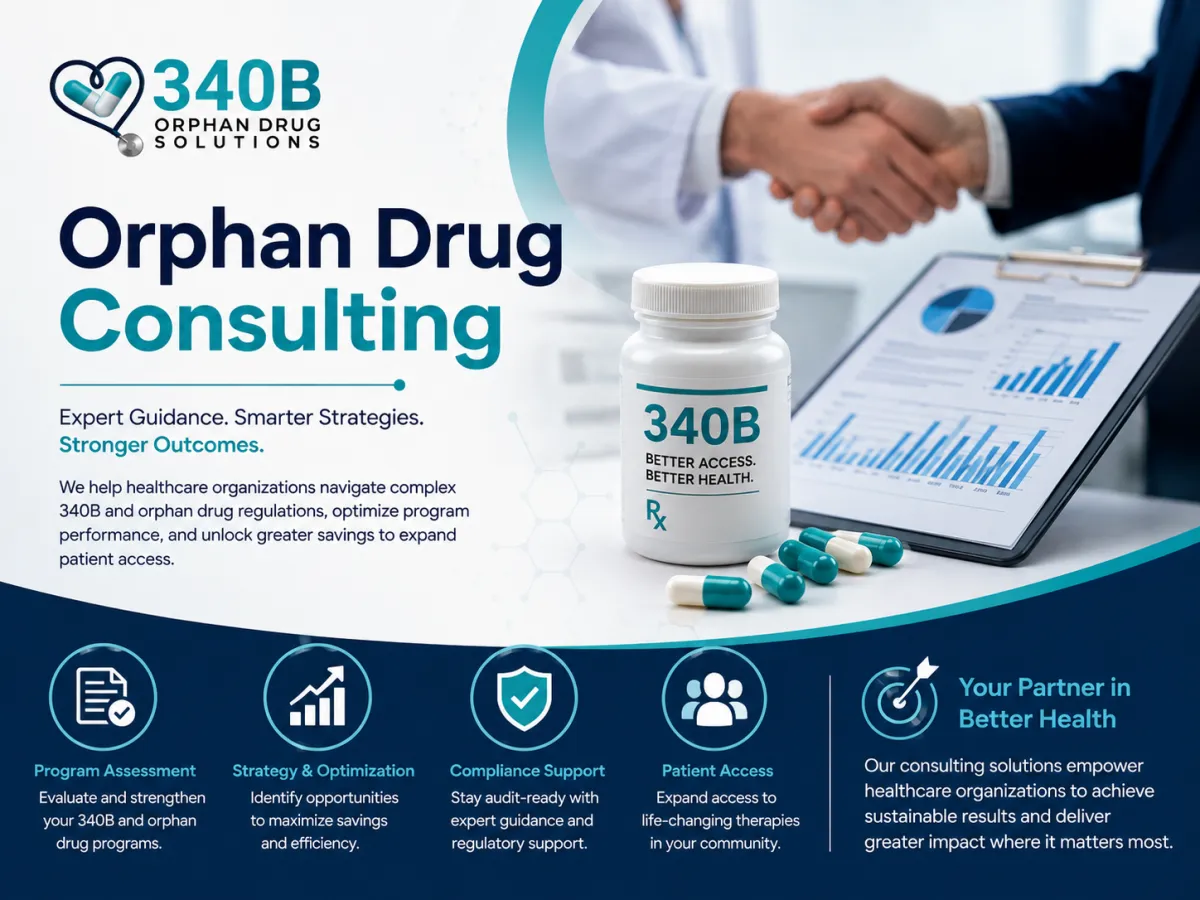
Orphan drug rules move fast. Few hospitals have the bandwidth to track every designation change on their own. That is where orphan drug consulting comes in. 340B Orphan Drug Solutions works alongside covered entities to sort out which orphan drugs qualify for 340B pricing, which ones fall under a manufacturer's discretionary discount, and where the gaps in your current process are costing you money. If you need orphan drug experts who live in this niche every day, you are in the right place.
Pharmacy directors and 340B coordinators are already stretched thin managing split billing and annual recertification. They are also occupied with oversight of contract pharmacies. Adding orphan drug tracking on top of that workload usually means it gets reviewed once a quarter, if at all. A dedicated orphan drug consulting partner closes that gap without asking your team to take on more work.
What is Orphan Drug Consulting?
Orphan drug consulting is specialized guidance that helps covered entities manage the intersection of orphan drug designations and the 340B Drug Pricing Program.
An orphan drug is any drug or biologic granted orphan status by the Food and Drug Administration (FDA). The FDA designates this status to drugs that treat, diagnose, or prevent a rare disease, generally one affecting fewer than 200,000 people in the United States.
Under Section 340B(e) of the Public Health Service Act, certain covered entity types cannot claim mandatory 340B pricing for orphan drugs. This makes expert review essential before assuming a drug is out of reach.
Orphan Drug Consulting Services
340B Orphan Drug Solutions offers a full range of pharmacy consulting and 340B compliance services. These services are built around orphan drugs specifically, not general 340B oversight.
Our key services include:
Orphan drug designation tracking against the FDA Office of Orphan Products Development database
Manufacturer discretionary pricing monitoring, updated as terms change
340B eligibility review by covered entity type. These entities include Disproportionate Share Hospitals (DSHs), critical access hospitals (CAHs), and freestanding cancer hospitals
Split billing software configuration support to capture every eligible discount
Custom quarterly reporting built around your facility's own drug formulary
Audit preparation and recordkeeping guidance for orphan drug purchases
Every engagement is built around your facility's existing workflow. We do not ask your team to adopt a new system from scratch.
Who This Orphan Drug Consulting Service is For
This service fits hospitals and health systems that already participate in the 340B Drug Pricing Program and want a closer look at their orphan drug spend specifically.
Our consulting service tends to be the right fit for:
CAHs and sole community hospitals (SCHs) navigating the orphan drug exclusion
DSHs with a growing specialty and infusion pharmacy footprint
Children's hospitals managing a high volume of rare disease patients
Pharmacy directors who need clearer reporting to bring to finance and compliance teams
If your facility is unsure whether it even qualifies as a covered entity, a 340B Program Compliance review is usually the right starting point before any orphan drug-specific work begins.
Why Work With 340B Consultants Who Specialize in Orphan Drugs
General 340B consultants often treat orphan drugs as a footnote. That gap is exactly why a narrower focus matters.
Here is why you should work with 340B consultants who specialize in orphan drugs:
Frequent Changes in Orphan Drug Pricing
Orphan drug pricing changes quarterly, manufacturer by manufacturer. A generalist consulting team may not catch a new discretionary discount until months after it takes effect. Thus, working with orphan drug experts means someone is watching those changes full time.
Requirement for Pattern Recognition
A dedicated team also brings pattern recognition. After years of reviewing orphan drug designations across many hospital types, an experienced consultant can flag a likely savings opportunity faster than a team encountering it for the first time.
340B Orphan Drug Solutions is led by a pharmacist who has:
More than a decade of orphan drug-specific experience
A longer career in healthcare
A track record of helping hospitals identify substantial orphan drug savings they had been missing.
That depth of experience is the difference between a generic compliance checklist and guidance that reflects what is actually happening in the orphan drug market right now.
340B Consulting Process Timeline
Most engagements follow a consistent path from first conversation to ongoing quarterly support.
Here is how our consulting process timeline looks:
| Stage | What Happens |
|---|---|
| Week 1 | Initial compliance review call and formulary intake |
| Weeks 2 to 3 | Orphan drug designation audit against your current purchasing data |
| Weeks 3 to 4 | Manufacturer discretionary pricing research and gap analysis |
| Week 5 | Custom report delivered with savings opportunities and compliance notes |
| Ongoing | Quarterly updates as designations and manufacturer pricing change |
340B Compliance Assessment Checklist
Before any recommendations are made, we start every engagement with a compliance assessment. This step matters because two hospitals with similar formularies can have very different orphan drug exposure depending on their entity type and purchasing history.
Here is what an ideal review should cover:
| Checklist Item | Purpose |
|---|---|
| Covered entity type confirmation | Determines which orphan drug exclusion rules apply to your facility |
| OPAIS registration accuracy | Confirms outpatient facilities and contract pharmacies are properly listed |
| Orphan drug designation status by NDC | Flags which drugs on your formulary currently hold orphan status |
| Manufacturer discretionary pricing terms | Identifies where voluntary discounts are available beyond the statutory minimum |
| Split billing configuration | Checks that your software correctly separates 340B and non-340 B claims |
| Recordkeeping and audit trail | Verifies documentation is ready if a manufacturer or federal audit occurs |
Common 340B Consulting Challenges & Solutions
Covered entities tend to run into the same few obstacles, quarter after quarter, regardless of size or region.
Here is how orphan drug consulting typically addresses those obstacles:
| Challenge | Consulting Solution |
|---|---|
| Manual tracking of orphan drug status takes hours each quarter | Automated tracking against the FDA orphan drug database, reviewed and reported to your team |
| Uncertainty over which entity type rules apply | Entity-specific eligibility review tied to current statute and HRSA guidance |
| Missed discretionary manufacturer discounts | Ongoing manufacturer pricing monitoring with proactive alerts |
| Difficulty preparing for audits | Structured recordkeeping support and documentation review before audits happen |
| Limited internal pharmacy staff bandwidth | Outsourced quarterly reporting that plugs into your existing workflow |
340B Consulting Benefits Comparison
It helps to see the difference between managing orphan drug tracking internally and bringing in dedicated support.
| Approach | Typical Outcome |
|---|---|
| Handled internally, part-time | Hours spent each quarter cross-checking designations manually, higher risk of missed discounts |
| General 340B consulting, not orphan specific | Broad compliance support, but orphan drug pricing changes may be reviewed less frequently |
| Dedicated orphan drug consulting | Focused quarterly tracking, discretionary pricing alerts, and audit-ready documentation |
Q1. What is an orphan drug company?
An orphan drug company is a pharmaceutical or biotech sponsor that develops drugs or biologics specifically for rare diseases. These drugs are generally for diseases affecting less than 200,000 people in the United States.
These sponsors submit designation requests to the FDA Office of Orphan Products Development. They do this to qualify their product for orphan status and its related incentives.
Q2. Is orphan drug designation a big deal?
This designation is a huge deal because:
● It qualifies a sponsor for tax credits on qualified clinical testing
● It makes the designated company eligible for a waiver of the prescription drug user fee.
● Also, designated companies potentially receive seven years of market exclusivity after approval.
● For a covered entity, it also determines whether a drug falls under the 340B orphan drug exclusion for certain hospital types.
Q3. What is the top-selling orphan drug?
The specific top seller changes from year to year as new drugs are approved, and older ones lose exclusivity. What is consistent is the therapeutic pattern. A federal review of FDA orphan drug approvals from 2008 to 2017 found that more than half were concentrated in oncology and hematology. These are the fields where many of the highest revenue orphan drugs tend to fall.
Q4. What is the FDA orphan drug exemption?
Any sponsor developing a drug or biologic to treat, diagnose, or prevent a rare disease can request orphan drug designation, provided the drug and the disease meet the criteria set out under the Orphan Drug Act.
Q5. Who pays for orphan drug development?
In most cases, the sponsor, meaning the pharmaceutical or biotech company, funds the bulk of development costs. The costs are often offset by orphan drug incentives such as tax credits and user fee waivers.
The FDA also runs its own Orphan Products Grants Program. The program is a congressionally funded program that awards grants directly to clinical investigators to help fund trials and natural history studies for rare disease products.
Q6. How do I submit an orphan drug designation?
Sponsors can submit an orphan drug designation request to the FDA Office of Orphan Products Development in one of three ways:
● Through the CDER NextGen portal
● By emailing the required information to [email protected], or
● By mail to the Office of Orphan Products Development in Silver Spring, Maryland.
The FDA 4035 form is designed to help sponsors organize the required content before submission.
Talk to an Orphan Drug Consulting Team That Knows This Space
Orphan drug rules will keep changing, and your covered entity should not have to absorb that risk alone. 340B Orphan Drug Solutions brings orphan drug expertise, pharmacy consulting, and 340B compliance services together in one team, so nothing falls through the cracks between quarterly updates. Schedule your compliance review today and find out what your facility may be missing.
Disclaimer
This content is provided for general informational purposes only and does not constitute legal, regulatory, reimbursement, or financial advice. All savings figures, examples, and calculations on this page are illustrative estimates, not guarantees. Actual 340B and orphan drug savings vary based on manufacturer pricing decisions, patient population, drug mix, and 340B compliance status. Covered entities should confirm current requirements directly with HRSA's Office of Pharmacy Affairs and consult qualified counsel before making compliance or purchasing decisions.
Maximizing savings. Ensuring compliance. Advancing access to life-changing therapies.


© 2026 340B Orphan Drug Solutions. All rights reserved.