Orphan Drug Exclusion: The 340B Rule Every Affected Hospital Needs to Get Right
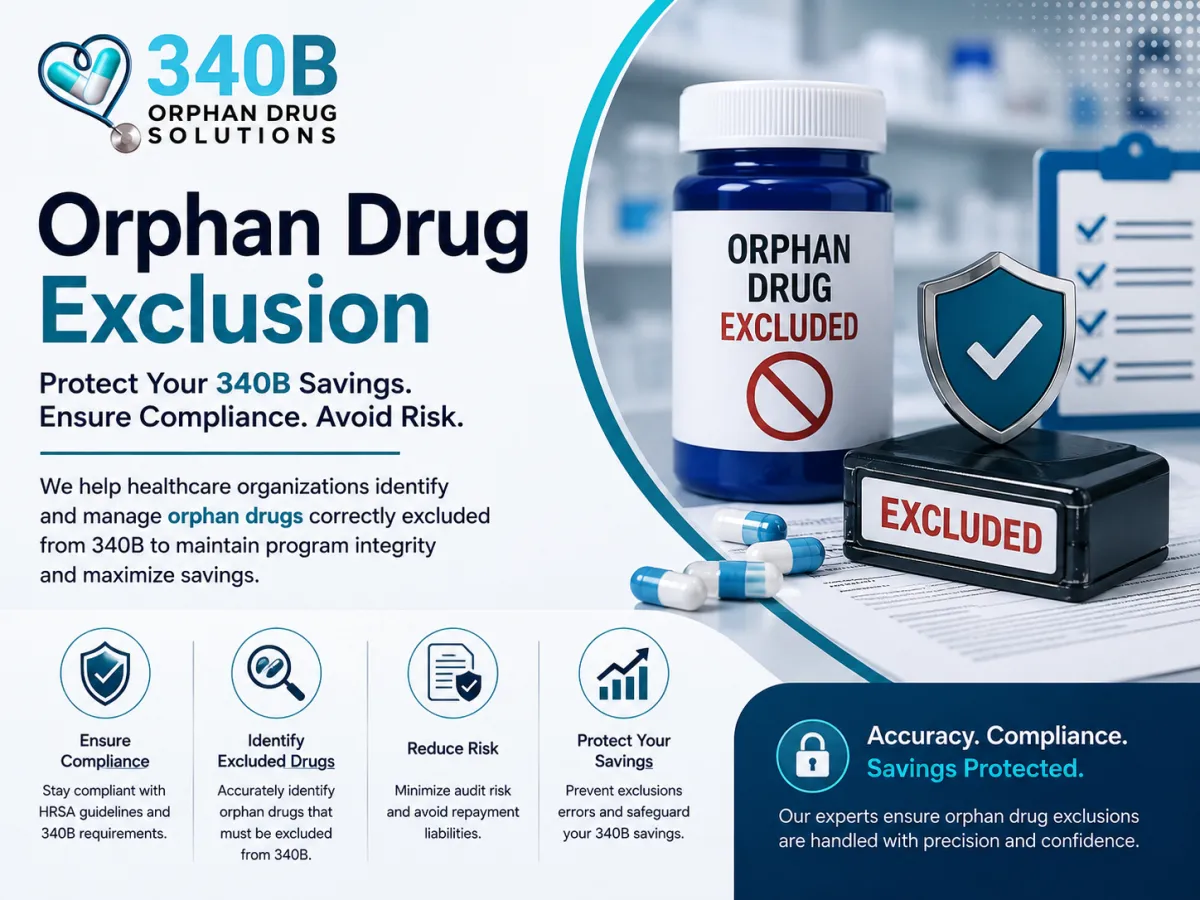
The orphan drug exclusion is the single most misunderstood rule in the 340B Drug Pricing Program. It does not apply to every hospital. It does not apply to every orphan drug. And getting it wrong, in either direction, creates real risk, whether that is a compliance finding or savings your hospital never captures.
Part of the confusion comes from the name itself. Hospitals often assume orphan drug exclusion means every orphan-designated drug is off limits for 340B pricing, everywhere, for every hospital. That is not what the rule says. It is narrower, more specific, and only relevant to a defined set of covered entity types.
Here is a compliance guide to the orphan drug exclusion. Know who it applies to, how it works, what the regulations require, and where the exceptions actually sit.
What is the Orphan Drug Exclusion?
The orphan drug exclusion is a 340B rule. This rule removes drugs designated to treat a rare disease or condition from the mandatory discount requirement. This exclusion is only for five specific hospital types and only when the drug is used to treat the condition it was designated for.
Congress built this exception into the Affordable Care Act when it expanded 340B eligibility to new hospital categories in 2010. Later on, the Health Resources and Services Administration (HRSA) finalized the implementing regulation in 2013.
Under this orphan drug rule:
A manufacturer is not required to sell an orphan drug at the 340B ceiling price to an affected hospital when that drug is dispensed for its orphan-designated use.
A manufacturer can still choose to offer a discount voluntarily. This is why tracking manufacturer decisions matters so much under this policy.
The rule exists as a trade-off. When the Affordable Care Act expanded 340B eligibility to Critical Access Hospitals (CAHs), Sole Community Hospitals (SCHs), Rural Referral Centers (RRCs), cancer hospitals, and children's hospitals, Congress carved out orphan drugs specifically to avoid discouraging manufacturer investment in rare disease treatment for these newly eligible facility types.
Orphan Drug Exclusion Eligibility
The exclusion applies only to the covered entity types the Affordable Care Act newly added to the 340B Program. Every other covered entity type keeps full access to 340B pricing on orphan drugs. It is the single most common point of confusion hospitals bring to a compliance review.
| Covered Entity Type | Subject to Orphan Drug Exclusion? |
|---|---|
| Critical Access Hospitals (CAHs) | Yes |
| Sole Community Hospitals (SCHs) | Yes |
| Rural Referral Centers (RRCs) | Yes |
| Free-standing Cancer Hospitals | Yes |
| Children's Hospitals | Yes |
| Disproportionate Share Hospitals (DSHs) | No |
| Federally Qualified Health Centers (FQHCs) and other federal grantees | No |
If a hospital qualifies under more than one category, such as a SCH that also meets DSH criteria, its primary 340B registration category determines whether the exclusion applies.
This is a detail worth confirming directly with HRSA. Confirmation is essential as it changes the entire compliance approach for that facility. Also, getting it wrong in your registration can create irreversible downstream problems for you.
Covered Entities Affected by the Orphan Drug Exclusion
The orphan drug exclusion mainly affects two groups of 340B covered entities. Identifying which group your hospital belongs to is important because it determines whether you can purchase certain orphan drugs at the 340B price. Also, it influences your compliance and purchasing processes.
Your covered entity type determines whether you have access to 340B pricing for orphan drugs, as summarized in the table below.
| Entity Group | 340B Orphan Drug Access |
|---|---|
| CAHs, SCHs, RRCs, Free-standing Cancer Hospitals, and Children's Hospitals | There is no guaranteed 340B pricing on orphan drugs used for the orphan-designated condition unless a manufacturer voluntarily opts in. |
| Disproportionate Share Hospitals (DSHs) and Federal Grantees | Full 340B ceiling price access on orphan drugs. They are treated the same as any other covered outpatient drug. |
Excluded vs Eligible Drug Categories
The HRSA orphan drug exclusion is not a blanket exclusion of a drug. It is specific to how the drug is used. The same orphan-designated drug can be excluded in one scenario and fully eligible in another. This is what makes this rule harder to administer than most other parts of the 340B program.
| Use Case | 340B Eligible for Excluded Entity Types? |
|---|---|
| Orphan drug used to treat its orphan-designated rare condition | Excluded, unless the manufacturer voluntarily offers a discount. |
| Same orphan drug used to treat a different, non-orphan condition | Eligible for standard 340B pricing. |
| Standard covered outpatient drug with no orphan designation | Eligible for standard 340B pricing. |
This is where most compliance gaps start.
A hospital that assumes an orphan-designated drug is always excluded can miss legitimate 340B savings on the non-orphan indication. A hospital that assumes the opposite can end up in a diversion finding. Neither error is intentional. Both come from treating a drug-level list as though it answers a use-level question.
Orphan Drug Exclusion Compliance Requirements
Affected hospitals have two compliance paths under the orphan drug policy. Every affected entity has to choose one and document that choice clearly in its internal compliance policy. Here are the two compliance paths you can choose from:
| Option | Description |
|---|---|
| Option 1 | You can track use by indication and keep auditable records proving the orphan drug was not used for its orphan-designated condition when purchased at the 340B price. |
| Option 2 | You can purchase all drugs carrying an orphan designation outside the 340B Program entirely, regardless of how they are used. |
Here is how your chosen path will change the functioning of your healthcare facility:
| Option | Description |
|---|---|
| Option 1 |
|
| Option 2 | It is simpler to administer but forgoes any 340B pricing on that drug entirely, even for indications that would otherwise qualify. |
The exclusion also extends to contract pharmacy arrangements. A contract pharmacy that cannot maintain auditable records sufficient to prove compliant use must purchase orphan drugs outside the 340B Program for that hospital as well.
This detail catches hospitals off guard often, since contract pharmacy compliance sometimes gets treated as a separate workstream from in-house 340B administration. It should always be considered an extension of the same policy.
Orphan Drug Exclusion Compliance Checklist
Your hospital’s pharmacy must follow the orphan drug exclusion compliance checklist mentioned below:
You should always confirm which of the five affected entity types applies to your hospital.
Thereafter, choose and document Option 1 or Option 2 in your compliance policy.
Then, you have to maintain the HRSA orphan drug list and cross-check it against your formulary quarterly.
Always extend the same tracking standard to every contract pharmacy location.
Furthermore, you should keep auditable records ready for HRSA or manufacturer review at any time.
The Orphan Drug Act and Why the Exclusion Exists
The Orphan Drug Act of 1983, Public Law 97-414, created the orphan drug designation. It was done to encourage development of treatments for diseases too rare to be commercially attractive on their own.
Food and Drug Administration (FDA) grants the designation to drugs treating conditions affecting fewer than 200,000 people in the United States. If this is not done, it would not recover development costs. In exchange of development of orphan drugs, sponsors receive:
Seven years of market exclusivity
Tax credits for clinical trial costs
Waived FDA application fees
Before 1983, drug companies had little financial reason to invest in treatments for small patient populations. Development costs stayed roughly the same regardless of how many patients a drug could eventually treat. Due to this, rare disease therapies consistently lost out to more profitable projects.
The Orphan Drug Act was designed specifically to change that calculation.
Congress added the 340B orphan drug exclusion decades later, in 2010. It was added to protect that incentive structure. Lawmakers were concerned that requiring 340B pricing on orphan drugs for newly eligible hospital types could undercut the very investment protections the Orphan Drug Act was designed to preserve.
The exclusion is, in effect, a narrow carve-out built to keep two different pieces of federal drug policy from working against each other.
Frequently Asked Questions
Q1. What is an orphan drug exclusion?
It is the 340B Program rule that removes a drug's mandatory ceiling price requirement for five specific hospital types, when that drug is used to treat the rare condition for which it received orphan designation. Outside of that specific use case, the same drug can still be fully 340B eligible.
Q2. Who is eligible for the orphan drug designation?
FDA grants orphan drug designation to sponsors developing a drug for a disease or condition affecting fewer than 200,000 people in the United States, or one where development costs are unlikely to be recovered from sales. The designation is granted to the drug and its sponsor, not to a hospital or provider.
Q3. What is an example of an orphan drug?
Cerezyme, used to treat Gaucher disease, and Zolgensma, used to treat spinal muscular atrophy, are both FDA orphan-designated drugs that illustrate how the exclusion can apply to high-cost rare disease therapies.
Q4. What is the FDA orphan drug exemption?
It refers to the incentive package under the Orphan Drug Act: seven years of market exclusivity, tax credits for qualified clinical trial costs, and waived new drug application fees for sponsors developing treatments for rare diseases.
Q5. Who prepares the orphan drug exclusion list?
HRSA develops and publishes the list quarterly, built from designation data pulled directly from the FDA Office of Orphan Products Development database. HRSA has stated the list should serve as the primary reference point for 340B stakeholders, though covered entities may still need to do additional analysis on specific drugs to confirm how the exclusion applies to their formulary.
Q6. What is the Orphan Drug Act?
It is the 1983 federal law that created the orphan drug designation and its financial incentives, passed specifically to encourage pharmaceutical development for rare diseases that otherwise had little commercial incentive behind them. It remains the foundation for how the FDA identifies which drugs the 340B orphan drug exclusion applies to today.
Not sure if the orphan drug exclusion applies to your hospital?
Talk to 340B Orphan Drug Solutions about a compliance review built around your entity type, your formulary, and your current tracking process.
Disclaimer
This content is provided for general informational purposes only and does not constitute legal, regulatory, reimbursement, or financial advice. All savings figures, examples, and calculations on this page are illustrative estimates, not guarantees. Actual 340B and orphan drug savings vary based on manufacturer pricing decisions, patient population, drug mix, and 340B compliance status. Covered entities should confirm current requirements directly with HRSA's Office of Pharmacy Affairs and consult qualified counsel before making compliance or purchasing decisions.
Maximizing savings. Ensuring compliance. Advancing access to life-changing therapies.


© 2026 340B Orphan Drug Solutions. All rights reserved.