Rural Hospital Pharmacy for 340B Compliance and Cost Savings
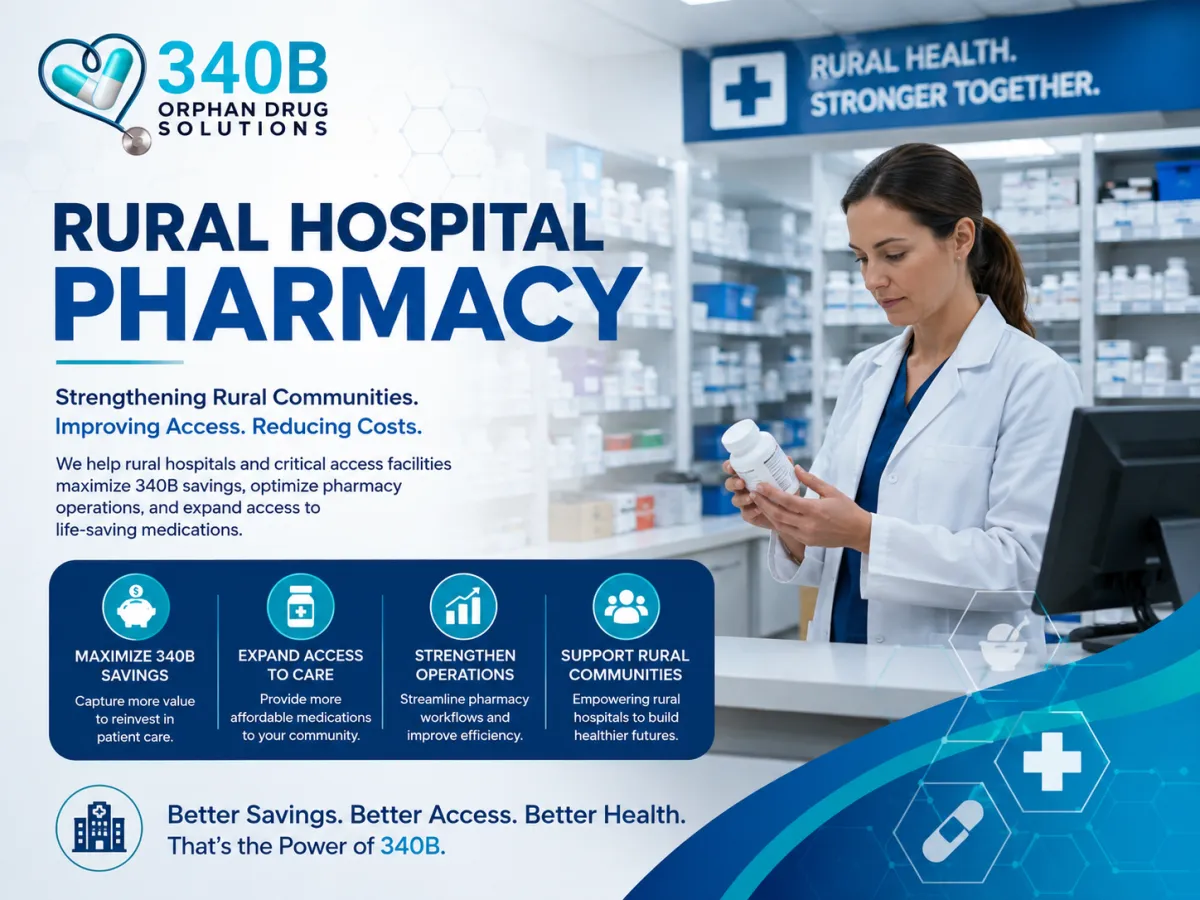
Rural hospital pharmacy runs on fewer staff, less budget, and less margin for error than pharmacy departments almost anywhere else in US healthcare. When something slips, whether that is a missed 340B discount or a staffing gap, the impact reaches patients faster in a community with one hospital than it does in a city with ten.
These are not separate problems. A rural hospital pharmacy short on staff is also the one least likely to catch a missed 340B discount. This is also the hospital that can least afford to lose that revenue.
Thus, if you are in charge of a rural hospital, you should understand the real challenges rural pharmacy teams face. Also, you should know how the 340B program fits into keeping these hospitals financially viable. Additionally, you should recognize where outside support closes the gaps a small team cannot cover alone.
The State of Rural Hospital Pharmacy in the US Today
The financial backdrop for rural pharmacy decisions is not abstract. This is evident from the U.S. Government Accountability Office (GAO) data, which is as follows:
64 rural hospitals closed between 2013 and 2017 alone. This is more than double the closures of the previous five-year period.
More than 100 rural hospitals closed nationwide between January 2013 and February 2020.
In recent years, financial distress has been driven largely by declining inpatient demand. This is evident across-the-board Medicare payment reductions.
When a rural hospital closes, residents travel roughly 20 miles farther for common services. They are compelled to travel about 40 miles farther for less common services such as substance use treatment.
The aforementioned data shapes every budget conversation a rural pharmacy leader has.
Against that backdrop, pharmacy is rarely just a clinical department at a rural hospital. It is one of the largest controllable cost centers in the building. Also, it is one of the few places where a well-run program can meaningfully improve the hospital's financial position and its patient outcomes.
Common Challenges Facing Rural Hospital Pharmacies
None of the challenges exist in isolation. A staffing shortage makes it harder to catch a 340B compliance gap. A compliance gap costs money the hospital cannot afford to lose. Breaking that cycle usually starts with whichever piece is easiest to fix first. For many rural hospitals, that is 340B and orphan drug tracking.
Here are the key challenges faced by rural pharmacies and why each issue has a grave impact on the hospital:
| Challenge | Why It Hits Rural Hospitals Hardest |
|---|---|
| Drug shortages | FDA's Drug Shortages Database lists hundreds of current shortages at any time. These may last for many years due to fewer backup suppliers available in rural markets. |
| Financial distress | Since 2013, declining inpatient demand and Medicare payment reductions have led to the closure of nearly 100 rural hospitals. |
| Workforce shortages | Rural counties consistently show fewer physicians and pharmacy staff per capita than urban counties. |
| Distance to care | When a rural hospital closes, residents travel roughly 20 miles farther for common services. They sometimes travel 40 miles farther for less common ones. |
| 340B compliance complexity | Health Resources and Services Administration (HRSA) requires the same diversion prevention and recordkeeping standards regardless of hospital size or staffing. |
Critical Access Hospital Pharmacy and the 340B Program
For many rural facilities, especially those designated as critical access hospitals (CAHs), the 340B program is not a nice-to-have. It is a core part of how the hospital stays financially viable at all.
Here is why critical access hospital pharmacy cannot treat 340B administration as a background task:
CAHs are eligible 340B covered entities under Section 340B(a)(4) of the Public Health Service Act.
HRSA, which administers the program, estimates enrolled covered entities achieve average savings of 25 to 50 percent on outpatient pharmaceutical purchases.
Participation in the 340B program grew more than 60 percent from 2011 to 2016. This was largely driven by newly eligible rural and critical access hospitals.
Critical access hospitals are one of the entity types subject to the orphan drug exclusion. This means orphan drug pricing depends on manufacturer discretion rather than a guaranteed discount.
Reducing Pharmacy Costs in Rural Healthcare
With HRSA estimating average 340B savings of 25 to 50 percent on outpatient drug purchases, even a modest improvement in how consistently that discount is captured can represent a meaningful share of a rural hospital's total pharmacy budget.
Cost control in a rural hospital pharmacy usually comes from a handful of reasons, which are as follows:
Maximize 340B ceiling price capture across the full outpatient drug formulary
Track orphan drug manufacturer discretionary pricing every quarter instead of once a year
Confirm annual 340B recertification is filed on time to avoid a lapse in eligibility
Reconcile Medicaid billing against 340B purchasing records to prevent duplicate discounts
Audit contract pharmacy arrangements regularly to catch reconciliation drift early
Common Compliance Issues in Rural Hospital Pharmacy
Compliance risk in rural pharmacy usually traces back to bandwidth, not intent. A small team covering a large scope of responsibility is more likely to miss something than a team with dedicated compliance staff.
| Compliance Issue | Common Root Cause |
|---|---|
| 340B diversion risk | Manual tracking with no dedicated coordinator to catch errors |
| Missed annual recertification | 340B administrative tasks deprioritized during staffing shortages |
| Contract pharmacy reconciliation gaps | Limited bandwidth to audit every dispensing location on a regular schedule |
| Duplicate discount errors | Medicaid billing not consistently cross-checked against 340B purchasing records |
| Orphan drug tracking lapses | No process for reviewing manufacturer discretionary pricing changes each quarter |
HRSA requires the same core compliance standards, diversion prevention, duplicate discount prevention, and accurate recordkeeping, regardless of whether a hospital has one pharmacist covering every duty or a full compliance department.
Technology That Improves Rural Pharmacy Operations
A few categories of technology are making a measurable difference for smaller pharmacy teams.
Telepharmacy, allowing remote pharmacist order verification for facilities that cannot staff around the clock
340B split billing software that flags eligible claims automatically instead of relying on manual review
Electronic health record integration that reduces manual data entry errors in medication management
HRSA's Federal Office of Rural Health Policy supports telehealth and telepharmacy expansion through its rural health grant programs, recognizing that remote pharmacist coverage is often the most realistic way for a small hospital to maintain safe medication verification without adding full-time headcount.
Why Use Pharmacy Consulting Services
Most rural hospitals cannot support a full-time 340B coordinator, a compliance pharmacist, and a Chief Pharmacy Officer all at once. Pharmacy consulting fills that gap without asking a small hospital to build out a department it cannot afford.
Specialized 340B and orphan drug tracking without adding a full-time salary
Compliance support built specifically for critical access hospital rules and thresholds
Quarterly reviews that catch manufacturer discretionary pricing changes before they cost real money
Reporting that hospital boards and finance committees can actually use
Given how directly 340B savings support ongoing operations at many critical access hospitals, the cost of a missed discount or a compliance finding is usually far higher than the cost of a focused consulting engagement.
Frequently Asked Questions
Q1. What challenges do rural hospital pharmacies face?
Rural hospital pharmacies contend with drug shortages, workforce shortages, financial distress tied to declining inpatient demand and Medicare payment reductions, and the compliance complexity of running a full 340B program with a small team.
Q2. How does the 340B program support rural hospitals?
The 340B program allows eligible rural hospitals, including critical access hospitals, to purchase outpatient drugs at a discounted price. HRSA estimates average savings of 25 to 50 percent, savings that are frequently used to support services the hospital could not otherwise afford to offer.
Q3. How can pharmacy costs be reduced?
Costs come down through maximizing 340B capture, tracking orphan drug discretionary pricing regularly, keeping recertification current, reconciling Medicaid billing against purchasing records, and auditing contract pharmacy arrangements on a consistent schedule.
Q4. What compliance issues are common at rural hospital pharmacies?
Common issues include 340B diversion risk from manual tracking, missed annual recertification, contract pharmacy reconciliation gaps, duplicate discount errors, and lapses in tracking orphan drug manufacturer discretionary pricing.
Q5. What technology improves rural pharmacy operations?
Telepharmacy for remote order verification, 340B split billing software, and electronic health record integration all help small teams cover more ground without adding staff, an approach HRSA's Federal Office of Rural Health Policy actively supports through its rural grant programs.
Q6. Why use pharmacy consulting services?
Consulting gives rural hospitals access to specialized 340B, orphan drug, and compliance expertise without the cost of a full in-house pharmacy leadership team, which matters most at facilities already operating on thin margins.
Running a rural or critical access hospital pharmacy on a lean team?
Talk to 340B Orphan Drug Solutions about compliance and savings support built specifically for rural hospital pharmacy budgets.
Disclaimer
This content is provided for general informational purposes only and does not constitute legal, regulatory, reimbursement, or financial advice. All savings figures, examples, and calculations on this page are illustrative estimates, not guarantees. Actual 340B and orphan drug savings vary based on manufacturer pricing decisions, patient population, drug mix, and 340B compliance status. Covered entities should confirm current requirements directly with HRSA's Office of Pharmacy Affairs and consult qualified counsel before making compliance or purchasing decisions.
Maximizing savings. Ensuring compliance. Advancing access to life-changing therapies.


© 2026 340B Orphan Drug Solutions. All rights reserved.