Manufacturer Discretionary Pricing Guide for 340B Hospitals
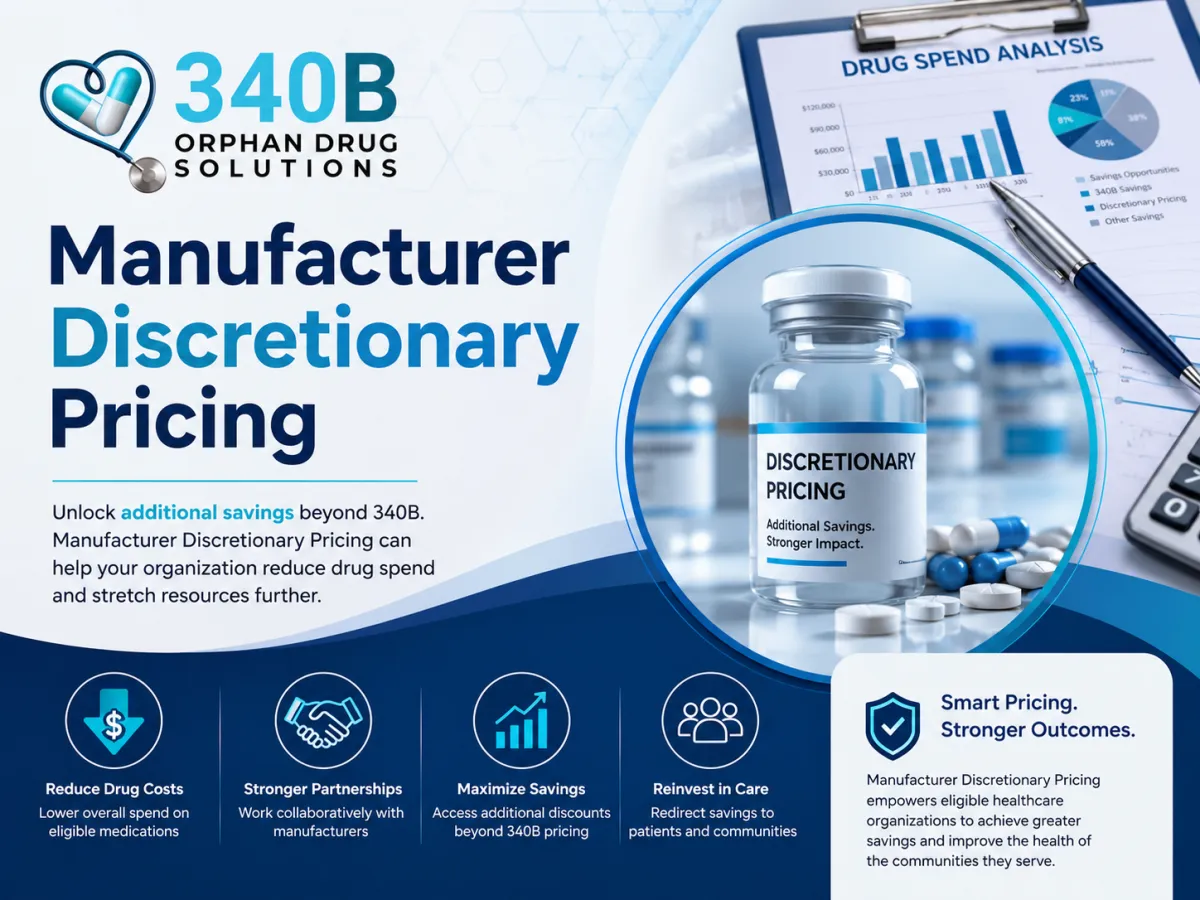
Most 340B pricing is guaranteed by statute. Manufacturer discretionary pricing is not. It is the piece of your drug budget that a manufacturer can offer, change, or withdraw on its own timeline. This discretionary pricing shows up almost entirely in one category, which is orphan drugs.
For a hospital pharmacy team, that difference matters more than it sounds. A guaranteed ceiling price is something you can build a stable forecast around. A discretionary price is something you have to check, drug by drug, regularly. Regular checking is essential because it can shift without any formal announcement reaching your team.
Thus, every healthcare unit needs to understand what discretionary pricing actually is and how it fits into the broader 340B price formula. Also, it is important to know why manufacturers choose to participate at all and what it takes to manage this part of your pharmacy budget with confidence.
What is Manufacturer Discretionary Pricing?
Discretionary pricing is a price a drug manufacturer chooses to offer. This price is not the same as that required by federal statute. Inside the 340B Drug Pricing Program, this term almost always refers to orphan drugs.
Under Section 340B(e) of the Public Health Service Act, orphan drugs are excluded from the mandatory ceiling price requirement for five specific hospital types. A manufacturer can still offer 340B pricing on that drug voluntarily, and many do, but nothing in the statute forces that decision.
That voluntary nature is exactly what makes this category different from the rest of your pharmacy budget. A manufacturer can begin offering a discretionary discount one quarter and quietly stop the next, with no formal notification requirement. For a hospital's drug cost management process, that turns one line of the formulary into a moving target.
Thus, it is worth being precise about the scope here too. Discretionary pricing does not apply to a hospital's entire drug spend. It applies only to orphan drugs used for their orphan-designated condition, and only at hospitals subject to the exclusion in the first place. Everything else on the formulary still runs on the standard, guaranteed ceiling price.
Mandatory Pricing vs Manufacturer Discretionary Pricing
Mandatory pricing and manufacturer discretionary pricing require very different levels of ongoing attention from your pharmacy and finance teams. Thus, it helps to see both the pricings.
Here is a comparative analysis of both pricing types:
| Pricing Type | How It Works |
|---|---|
| Mandatory 340B ceiling price |
|
| Manufacturer discretionary pricing |
|
The 340B Price Formula
Even discretionary pricing is usually built around the same underlying formula that governs standard 340B ceiling prices. It is so because most manufacturers use it as their reference point when deciding what to offer.
Here is the ceiling price formula and its components:
Formula
Ceiling Price = AMP-URA| Component | What It Means |
|---|---|
| Average Manufacturer Price (AMP) | It is based on the smallest billable unit of the drug. |
| Unit Rebate Amount (URA) |
|
HRSA recalculates the ceiling price every quarter. It uses AMP and URA data manufacturers report to the Centers for Medicare & Medicaid Services (CMS).
Discretionary orphan drug pricing tends to track close to this same ceiling when a manufacturer opts in. However, the manufacturer is not bound to match it exactly. This is another reason it needs to be confirmed rather than assumed each quarter.
Why Manufacturers Participate in 340B
Participation in the 340B Program is tied directly to a manufacturer's participation in Medicaid. A manufacturer that wants its drugs covered under Medicaid and Medicare Part B has to sign a pharmaceutical pricing agreement with the U.S. Department of Health and Human Services (HHS). This agreement requires honoring 340B ceiling prices on covered outpatient drugs.
For most of a manufacturer's portfolio, this is not really optional in practice. Medicaid and Medicare Part B represent too large a share of the market for most manufacturers to walk away from. Thus, signing the pricing agreement becomes a standard cost of doing business in the United States.
For orphan drugs specifically, participation is more of a business decision. A manufacturer weighs the goodwill and market access of offering a discount against the revenue impact of doing so. They compare factors like competition, hospital relationships, and how many covered entities are likely to prescribe the drug.
In brief, here is why manufacturers participate in 340B:
Medicaid and Medicare Part B market access requires signing a pricing agreement
Discretionary orphan drug discounts often support long-term hospital and provider relationships
Manufacturers weigh competitive pressure and drug-specific market dynamics case by case
A manufacturer facing a competing therapy may offer discretionary pricing more readily than one with no direct competitor
Discretionary Pricing and Orphan Drug Incentives
The reason orphan drugs get this special treatment traces back to the Orphan Drug Act of 1983. The act built a set of incentives to encourage development of treatments for rare diseases that would otherwise struggle to attract investment.
| Incentive | What It Provides |
|---|---|
| Market exclusivity | Seven years of exclusivity for the approved orphan indication |
| Tax credits | Credit for a portion of qualified clinical trial costs |
| Fee waivers | Waived FDA new drug application fees |
| Grant funding | Eligibility for FDA orphan products research grants |
Congress added the 340B orphan drug exclusion in 2010. They did this to avoid undercutting these incentives for the hospital types newly added under the Affordable Care Act.
Discretionary pricing is the middle ground that resulted. It gives manufacturers the choice without removing it as a statutory requirement. It preserves the investment case for rare disease drug development while still leaving room for hospitals to negotiate or receive voluntary discounts.
Impact on Hospital Drug Budgets
For pharmacy leadership, discretionary pricing turns budgeting into a moving exercise rather than a fixed one. A hospital drug budget built around last quarter's orphan drug discounts can be inaccurate within a few months if a manufacturer's pricing decision shifts.
Quarter over quarter budget variance on high-cost orphan drug lines
Risk of overpaying if a discount is missed after it becomes available
Risk of a compliance issue if 340B pricing is applied after a discount is withdrawn
Added complexity for finance teams trying to forecast pharmacy spend accurately
None of this is a reason to avoid orphan drugs. It is a reason to build a pharmacy budget optimization process that checks discretionary pricing status on a fixed schedule instead of reacting after invoices arrive.
Hospitals that treat this as a recurring finance task tend to build far more accurate forecasts over time. The reason being finance and pharmacy work from the same current information instead of last quarter's assumptions.
Drug Procurement and Pharmacy Budget Optimization Strategies
A few practical habits keep discretionary pricing from becoming a budget surprise, and none of them require a large change to your existing procurement setup.
Review manufacturer discretionary pricing status for every orphan drug on your formulary each quarter
Build a drug pricing strategy that separates guaranteed 340B savings from discretionary savings in your forecasting
Flag high-volume or high-cost orphan drugs for closer, more frequent tracking
Keep procurement and finance aligned on current pricing status before purchase orders go out
Document every discretionary pricing change for audit and budgeting history
Hospitals that build this into a routine tend to see steadier hospital pharmacy costs over time, simply because fewer surprises make it into the budget in the first place. The goal is not to eliminate variability, since manufacturer decisions are outside a hospital's control, but to shrink the gap between when a change happens and when your team actually finds out about it.
Frequently Asked Questions
Q1. What is the 340B price formula?
The 340B ceiling price equals the Average Manufacturer Price, or AMP, minus the Unit Rebate Amount, or URA. HRSA recalculates this figure every quarter using pricing data manufacturers report to CMS.
Q2. Are manufacturers required to participate in 340B?
Only indirectly. Participation is not mandatory on its own, but any manufacturer that wants its drugs covered under Medicaid and Medicare Part B must sign a pricing agreement that requires honoring 340B ceiling prices on covered outpatient drugs. In practice, most manufacturers sign because those markets are too significant to opt out of.
Q3. Why do drug manufacturers participate in 340B?
Mainly to keep access to the Medicaid and Medicare Part B markets. For orphan drugs specifically, offering discretionary pricing is a separate business decision manufacturers make based on competition, hospital relationships, and market strategy.
Q4. What is the 340B Drug Pricing Program?
It is the federal program under Section 340B of the Public Health Service Act that allows qualifying hospitals and clinics to purchase outpatient drugs at a capped ceiling price, administered by HRSA.
Q5. What incentives are there for orphan drugs?
Manufacturers developing orphan drugs can receive seven years of market exclusivity, tax credits for qualified clinical trial costs, waived FDA application fees, and eligibility for orphan products research grants. These incentives are also the policy reason discretionary pricing exists instead of a mandatory discount for this drug category.
Q6. What does discretionary pricing mean?
It means a price a manufacturer chooses to offer voluntarily rather than one required by law. In 340B, this applies almost exclusively to orphan drugs for certain hospital types, and the discount can change without formal notice, which is why ongoing monitoring matters more here than anywhere else in the 340B formulary.
Tired of discretionary pricing catching your budget off guard?
Talk to 340B Orphan Drug Solutions about a quarterly discretionary pricing review built around your hospital's actual orphan drug formulary.
Disclaimer
This content is provided for general informational purposes only and does not constitute legal, regulatory, reimbursement, or financial advice. All savings figures, examples, and calculations on this page are illustrative estimates, not guarantees. Actual 340B and orphan drug savings vary based on manufacturer pricing decisions, patient population, drug mix, and 340B compliance status. Covered entities should confirm current requirements directly with HRSA's Office of Pharmacy Affairs and consult qualified counsel before making compliance or purchasing decisions.
Maximizing savings. Ensuring compliance. Advancing access to life-changing therapies.


© 2026 340B Orphan Drug Solutions. All rights reserved.