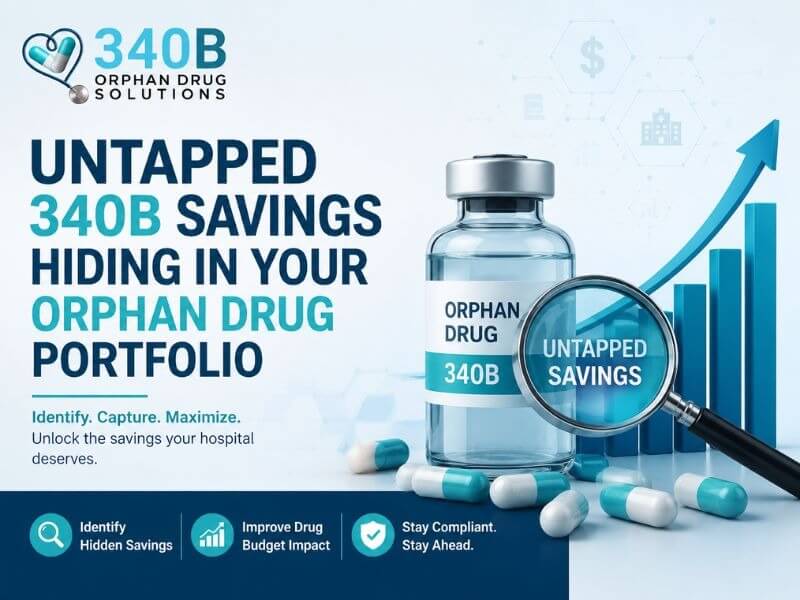
Untapped 340B Savings Hiding in Your Orphan Drug Portfolio
Rural hospitals operate under some of the most constrained financial conditions in American healthcare. According to the HHS Office of the Assistant Secretary for Planning and Evaluation (ASPE), since 2010, eight percent of rural hospitals in America have closed or converted to outpatient-only facilities. This is as per ASPE’s data on rural hospital closures and conversions.
These closed or converted hospitals include Critical Access Hospitals (CAHs), Sole Community Hospitals (SCHs), Rural Referral Centers (RRCs), and Freestanding Cancer Centers. Every recoverable dollar matters for these healthcare facilities.
Most of these facilities have functioning 340B programs. Fewer know that a significant category of orphan drug savings sits almost entirely outside the reach of those programs. It goes unrecovered quarter after quarter and does not require the pharmacy team to do more work to fix. Owing to these reasons, untapped 340B savings accumulate every quarter.
To address this, you should have in-depth knowledge of Section 340B, the 2015 ruling, and the reasons behind revenue loss. Keep reading for details.
What Makes Orphan Drug Savings Different from Standard 340B Savings?
The 340B Drug Pricing Program was established by Public Law 102-585. It was codified at 42 U.S.C. Section 256b, as part of the Veterans Health Care Act of 1992. Under Section 340B(a)(1) of the Public Health Service Act, manufacturers participating in the Medicaid Drug Rebate Program must enter into a pharmaceutical pricing agreement with the HHS Secretary. Also, they need to sell covered outpatient drugs to eligible covered entities at or below a statutory ceiling price.
According to the US Government Accountability Office (GAO), covered entities can realize substantial savings through 340B price discounts of an estimated 20 to 50 percent of drug costs.
The Affordable Care Act of 2010 expanded 340B eligibility to four new hospital types and simultaneously carved out a statutory exception for them under Section 340B(e) of the PHSA. Drugs holding an FDA orphan drug designation under Section 526 of the Federal Food, Drug, and Cosmetic Act are excluded from the mandatory 340B ceiling price for these expansion entities.
The four entity types subject to this exclusion are:
Critical Access Hospitals (CAHs)
Sole Community Hospitals (SCHs)
Rural Referral Centers (RRCs)
Freestanding Cancer Centers
Disproportionate share hospitals, children's hospitals, and federally qualified health centers are not subject to this exclusion. It applies exclusively to the expansion entities added by the ACA. As HRSA confirms on its official orphan drug exclusion page, manufacturers are not required to provide these covered entities with orphan drugs under the 340B program. A manufacturer may choose to offer discounts on those drugs at its sole discretion.
If you realise the significance of the 340B program, you can increase your untapped 340B savings hiding in your orphan drug portfolio.
An orphan drug is any drug or biologic designated by the FDA under Section 526 of the FFDCA to treat a rare disease or condition affecting fewer than 200,000 people in the United States. The FDA Office of Orphan Products Development maintains the official designation database. HRSA draws from that database to publish its quarterly orphan drug exclusion list, which covered entities must use as the primary compliance reference.
The financial weight of this exclusion is substantial. The GAO confirmed in its 2023 report on 340B hospital eligibility that manufacturers are not required to provide orphan drugs at the 340B discounted price to SCHs, CAHs, and RRCs, among other expansion entities. This represents a significant category of drug spending that sits outside mandatory program savings.
2015 Court Ruling: Essential to Understand Your Healthcare Facility’s Untapped 340 B Savings
Before October 2015, HRSA took the position that the orphan drug exclusion applied only when a drug was dispensed for its FDA-designated orphan indication. Under that reading, a hospital could access mandatory 340B pricing on an orphan-designated drug if it documented a non-orphan clinical use. HRSA published a formal rule to this effect in July 2013.
On October 14, 2015, the U.S. District Court for the District of Columbia ruled in Pharmaceutical Research and Manufacturers of America v. U.S. Department of Health and Human Services that the statutory text excludes orphan-designated drugs categorically from mandatory 340B pricing at expansion entities. This is regardless of the indication for which the drug is dispensed. The court vacated HRSA's interpretive guidance. The indication-based pathway to mandatory savings was closed.
The court ruling did not eliminate orphan drug savings. It changed the mechanism required to access them. Most rural hospitals treated that change as a closed door rather than a shifted one.
What the ruling did not do is identify where the untapped opportunity lives. It did not prohibit manufacturers from voluntarily offering discounted pricing on orphan drugs to expansion entities. HRSA confirms this directly: a manufacturer may, at its sole discretion, offer discounts on orphan drugs to these hospitals. That voluntary channel, what the industry calls discretionary pricing or sub-WAC pricing, has been available since the 2015 ruling.
Most facilities have not pursued it consistently, and HRSA itself has published a manufacturer availability list acknowledging that certain manufacturers have chosen not to offer this voluntary pricing at all. If you pursue it consistently, you can easily profit from untapped 340B savings.
Three Reasons Untapped 340B Savings Accumulate Every Quarter
If your facility is also accumulating untapped savings every quarter, you need to identify the operational gaps. Your healthcare facility must be facing the following issues:
Orphan Drug List is Outdated
HRSA updates the orphan drug exclusion list every quarter. It draws the list directly from the FDA Office of Orphan Products Development designation records. FDA grants New orphan designations on a rolling basis. Existing drugs receive new designated indications, new pediatric formulations, and new dosing forms that may each carry their own orphan status.
Most facilities maintain an orphan drug list assembled during the initial 340B program setup. That list reflects what was accurate at a fixed point in the past. Drugs added to the FDA designation database after setup are missing entirely. New indications for drugs already listed may not be captured. And drugs that have lost orphan status, which should re-enter the mandatory 340B channel, may still be treated as excluded.
A stale list means stale purchasing decisions, compounding the revenue gap every quarter it goes unmaintained. So you need to update your list regularly to not miss out on untapped 340B savings.
Voluntary Pricing Channel Has Never Been Engaged
To engage with the voluntary pricing channel, you need to identify the orphan-designated drugs. Thereafter, you have to secure voluntary discretionary pricing from the manufacturers of those drugs.
HRSA has acknowledged that manufacturer participation in voluntary orphan drug pricing is uneven. On its manufacturer availability page, HRSA has listed manufacturers that have chosen not to offer voluntary 340B-like pricing on their orphan-designated products to expansion entities.
However, other manufacturers do offer voluntary pricing on specific drugs. But knowing who is currently offering what, on which products, and through which purchasing channels requires active, ongoing engagement that no standard 340B program delivers automatically.
Without that engagement, voluntary pricing simply goes unrequested. The hospital continues purchasing at or near wholesale acquisition cost while the facility’s untapped 340B savings accumulate.
Purchasing Workflow is Not Configured to Capture the Savings
The third failure happens even after the first two are addressed. When discretionary pricing has been secured, the savings only materialize if the operational pathway to capture them is correctly built and maintained.
You must put these things in place simultaneously:
Your facility must have split-billing software that reflects the current state of each discretionary pricing agreement.
Thereafter, you should hire pharmacy purchasing staff who know which drugs have voluntary pricing available. They should also know which acquisition channel to use, and what to do when a purchase routes through the wrong pathway.
Furthermore, you should have a credit and rebill review process that identifies prior purchases that qualified for discounted pricing but were not captured. Also, the review should recover those savings retroactively before the window closes.
How to Ensure Non-Accumulation of Untapped 340B Savings?
A well-run 340B program does not deliver under-recovering orphan drug savings by design. This can only be addressed by dedicated orphan drug engagement.
Closing that gap requires four specific capabilities that generalist 340B administration does not deliver. The capabilities are as follows:
Quarterly monitoring of the FDA orphan drug designation database for changes that affect the facility's portfolio.
Active, manufacturer-by-manufacturer outreach to identify and secure voluntary pricing on currently available programs.
Retroactive credit and rebill review for purchases that qualified for discounted pricing but were not routed correctly.
Quarterly split-billing software updates as the orphan drug list and pricing agreements change.
What Does Closing the Gap Look Like in Practice?
Here is what you will observe when you focus on the aforementioned capabilities to leverage the untapped 340B savings:
A structured orphan drug revenue engagement addresses all three failure points in sequence. Every step is custom-built around the specific facility.
A case-mix and orphan drug purchase analysis identifies every orphan-designated drug the facility is currently buying. This list includes drugs that are absent from the current list, cross-referenced against the current HRSA quarterly exclusion list and the FDA OOPD designation database.
A customized orphan drug list is built around the facility's actual portfolio. It needs to be maintained with automated quarterly updates as HRSA refreshes the exclusion list. It should also feature monthly alerts when new FDA designations affect the portfolio.
Direct manufacturer outreach secures voluntary discretionary pricing on applicable drugs, with credit and rebill review for prior purchases that qualified for discounted pricing but were not routed through the correct channel.
Split-billing software is configured to reflect current agreements, and job aids are provided to pharmacy purchasing staff so orphan drug savings are captured at the point of acquisition every quarter.
The engagement typically pays for itself within the first quarter. From that point, the facility operates with a maintained orphan drug program that generates revenue continuously without placing the ongoing maintenance burden on the pharmacy team.
Find Out What Your Hospital Is Missing
If your CAH, SCH, or RRC has never had a dedicated orphan drug revenue review, there is a high probability you are under-recovering. The findings rate across every engagement completed by 340B Orphan Drug Solutions is 100 percent.
We offer a free 30-minute orphan drug revenue assessment exclusively for CAHs, SCHs, and RRCs. In that conversation, you will hear exactly what we would look at, what we would likely find, and whether our engagement model is the right fit for your facility.