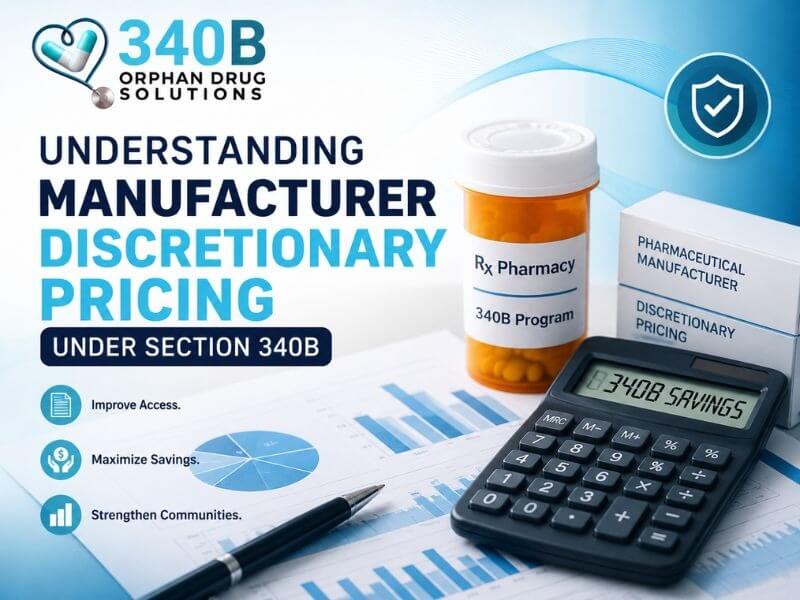
Understanding Manufacturer Discretionary Pricing Under Section 340B
For Critical Access Hospitals (CAHs), Sole Community Hospitals (SCHs), Rural Referral Centers (RRCs), and Freestanding Cancer Centers, one financial question matters more than almost any other in pharmacy operations right now: what is available in manufacturer discretionary pricing for orphan-designated drugs, and are we capturing it?
The mandatory Section 340B ceiling price does not apply to orphan drugs at these four entity types. That has been settled law since 2015. What many hospital finance and pharmacy teams have not kept pace with is what replaced it and how much that replacement has shrunk since 2021. Also, these expansion entities do not know what a facility must do to capture what remains.
What Manufacturers Are Legally Required to Do Under Section 340B of the Public Health Service Act?
The 340B Drug Pricing Program was established in 1992, under Public Law 102-585. In the same year, the program was codified at 42 United States Code (USC) Section 256b.
Under Section 340B(a)(1) of the Public Health Service Act (PHSA), any manufacturer participating in the Medicaid Drug Rebate Program must enter into a pharmaceutical pricing agreement with the Secretary of Health and Human Services (HHS). That agreement requires the manufacturer to sell covered outpatient drugs at or below the statutory ceiling price to eligible covered entities.
The ceiling price is calculated by subtracting the Unit Rebate Amount (URA) from the Average Manufacturer Price (AMP) for the smallest unit of measure. It is then adjusted for package and case size.
According to a 2015 MedPAC analysis, 340B participants received discounts of 20 to 50 percent on most outpatient drugs relative to average market prices. As per the analysis, for rural hospitals, the margin funds provide services that their communities could not otherwise access.
As per the Health Resources and Services Administration (HRSA) Office of Pharmacy Affairs, in 2023, covered entities purchased 66.3 billion dollars in outpatient drugs through the program. By 2024, that figure had grown to 81.4 billion dollars. In 2024, the high-cost specialty drugs purchased through specialty channels accounted for 61.5 percent of total 340B spending by dollar value. This number was even though only 40 percent of outpatient drugs were purchased by covered entities.
That mandatory pricing obligation, however, does not extend uniformly to every drug at every entity type. One category is carved out by statute, and it is the category that carries the highest per-unit cost in most rural hospital formularies. This category of drugs is known as ‘Orphan Drugs’
Orphan Drug Exclusion: What the Statute Says
The Affordable Care Act of 2010 expanded 340B eligibility to four new hospital types, which are CAHs, SCHs, RRCs, and Freestanding Cancer Centres. It simultaneously carved out an exception for them under Section 340B(e) of the PHSA. As per this amendment, drugs carrying a Food and Drug Administration (FDA) orphan drug designation under Section 526 of the Federal Food, Drug, and Cosmetic Act are excluded from the mandatory ceiling price obligation for these expansion entities.
An orphan drug is any drug or biologic designated by the FDA to treat a rare disease or condition affecting fewer than 200,000 people in the United States. This is defined under the Orphan Drug Act of 1983.
HRSA publishes a quarterly orphan drug exclusion list. It is updated directly from the FDA Office of Orphan Products Development designation records, which covered entities must use as the primary compliance reference.
The exclusion does not apply to disproportionate share hospitals, children's hospitals, or federally qualified health centers. It applies specifically to CAHs, SCHs, RRCs, and Freestanding Cancer Centers.
What is Manufacturer Discretionary Pricing?
On October 14, 2015, the U.S. District Court for the District of Columbia ruled in PhRMA v. HHS or PhRMA v. Burwell that the orphan drug exclusion applies categorically to all orphan-designated drugs at expansion entities. It is regardless of the indication for which the drug is dispensed. With this ruling, the District Court declared the HRSA interpretation that had allowed indication-based carve-ins as invalid.
The court did not prohibit manufacturers from voluntarily offering discounted pricing on orphan-designated drugs to expansion entities. That channel remained open. The mandatory obligation was gone. A voluntary mechanism took its place.
The ruling stated that “Manufacturer discretionary pricing is the voluntary, manufacturer-set pricing channel that emerged after 2015 to fill the gap left by the removal of the mandatory Section 340B ceiling price on orphan drugs for expansion entities.”
In contemporary times, discretionary pricing goes by several names in the US healthcare industry, which are as follows:
Voluntary 340B pricing
340B-like pricing
Sub-WAC pricing
Program-specific discounts.
In every case, the manufacturer determines, on a drug-by-drug basis, whether to offer a discount to CAHs, SCHs, RRCs, and Freestanding Cancer Centers and at what level. The covered entity must actively identify the opportunity, request access, and configure its purchasing workflow to capture it.
How the Landscape of Discretionary Pricing in the US Has Shifted Since 2021?
In recent years, three of the largest orphan drug manufacturers in the US have ended or largely reduced their voluntary discretionary pricing programs for expansion entities. These manufacturers are Janssen, AstraZeneca, and AbbVie,
Three of the largest orphan drug manufacturers in the country have ended or significantly curtailed their voluntary discretionary pricing programs for expansion entities in recent years. This is not a rumor or a projection. It is documented in manufacturer update communications published by distributors and confirmed by 340B-focused trade reporting.
Let us look at the key details for the three strongest players:
Johnson and Johnson (Janssen)
From 1 January 2022 onwards, Johnson and Johnson ended its voluntary 340B pricing on all orphan-designated drugs. The company terminated its discretionary pricing for covered entities subject to the orphan drug exclusion. This was done for the entire orphan drug portfolio of the company, which affected CAHs, SCHs, RRCs, and Freestanding Cancer Centers.
AstraZeneca
Likewise, AstraZeneca ceased offering voluntary 340B pricing on orphan-designated drugs to all four expansion entity types in June 2022. Unlike Janssen, AstraZeneca did not end voluntary pricing on the entire orphan drug portfolio. Some products were partially restored under separate arrangements. However, the broad voluntary pricing program for expansion entities came to an end.
AbbVie
Similarly, AbbVie ended all voluntary 340B-like pricing on its orphan-designated drugs for covered entities subject to the orphan drug exclusion. They did this on 1 August 2024. This change was applicable across its full orphan drug portfolio for all four expansion entity types.
Even though the discretionary pricing channel is narrower than it was in 2019, it has not closed.
What Remains Available Under Discretionary Pricing and What Hospitals Must Do to Capture Voluntary Pricing?
Drug manufacturers continue to offer voluntary discretionary pricing on specific orphan-designated products. The terms, eligible products, and entity types for each manufacturer may vary. Thus, identifying who is currently offering what requires active, ongoing monitoring. So, you should get an experienced 340B orphan drug savings estimator who will help your CAH, SCH, RRC, or Freestanding Cancer Center save a lot of money.
Since orphan drugs account for a disproportionate share of rural hospital drug budgets, the financial stakes of getting this right are higher than ever. Here are the three things you must do consistently as a hospital owner:
Maintain a current, facility-specific orphan drug list. The FDA grants new designations on a rolling basis, and HRSA updates the exclusion list every quarter. A static list from program setup is not sufficient for capturing what is available now.
Conduct active, manufacturer-by-manufacturer outreach. There is no central enrollment, no automatic notification when a program opens or closes, and no standardized application process across manufacturers. Hospitals must know who is offering voluntary pricing, on which drugs, and through which channels right now.
Configure split-billing software and purchasing workflows to convert agreements into actual savings. Negotiated pricing that is not routed through the correct purchasing channel at the point of acquisition generates no savings. Credit and rebill review is the safety net, but it is not a substitute for correct configuration from the start.
Find Out What Your Hospital is Leaving on the Table
Since 2021, the landscape of manufacturer discretionary pricing has shifted significantly. If your CAH, SCH, or RRC has not had a dedicated orphan drug revenue review in the past 12 months, your purchasing data almost certainly does not reflect what is currently available.
We offer a free 30-minute orphan drug revenue assessment for CAHs, SCHs, and RRCs. You will hear exactly what we would look at and whether our engagement model is right for your facility.
Email us at [email protected] for a direct conversation about your orphan drug portfolio