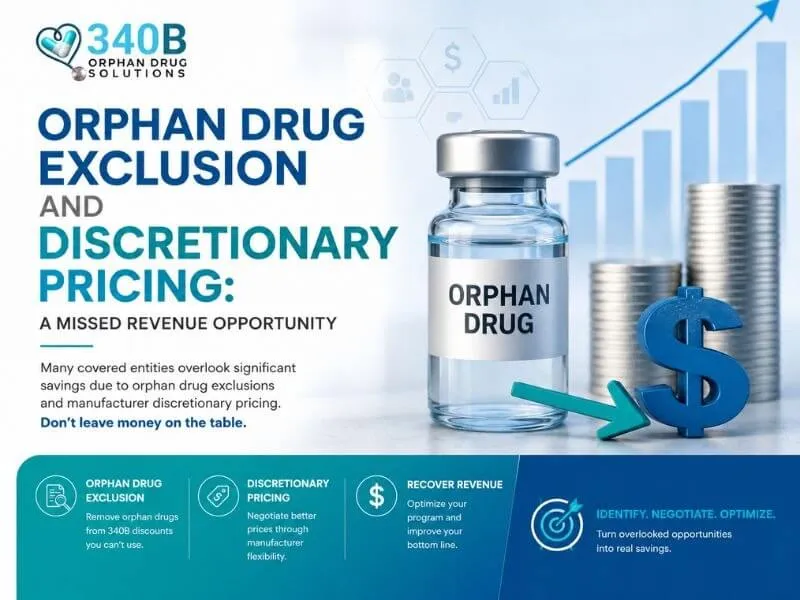
Orphan Drug Exclusion and Discretionary Pricing: A Missed Revenue Opportunity
In the American healthcare system, rural hospitals carry one of the heaviest medication cost burdens. Most of the drugs theypurchaseare specialty and biologic agents, which are extremely expensive.
If your Critical Access Hospital (CAH), Sole Community Hospital (SCH), or Rural Referral Center (RRC)participatesin the 340B Drug Pricing Program, you must be aware that the orphan drug exclusion affects how your facility accesses pricing on certain high-cost medications. Most pharmacy teams know the exclusion exists.However, very few understand what it actually means in practice or what it costs them every quarter to get it wrong.
This is not a theoretical gap. Inthe ruralhospitals of the US, this exclusion policy is one of the most consistently misunderstood provisions in the 340B space.
To help you navigate the gap, we have explained what orphan-designated drugs are and thedifferent aspectsof the exclusion policy.
What is an Orphan-Designated Drug?
As per the Orphan Drug Act of 1983, the Food and Drug Administration (FDA)designatesa drug as an orphan when it is intended to treat a rare disease or condition. The rare disease must affect fewer than 200,000 people in the United States.
The FDA Office of Orphan Products Development (OOPD)maintainsthe official designation list. At the same time, the Health Resources and Services Administration (HRSA) administers the 340B program. HRSA also updates its 340B-specific exclusion list quarterly.
What is the Orphan Drug Exclusion?
To understand this, we need to learn about itsorigin. The origin can be traced to the Affordable Care Act of 2010. With this act, the following changes were made to the 340B Drug Pricing Program:
Congress expanded the 340B program and included the following entities under this program:
Sole Community Hospitals (SCHs)
Critical Access Hospitals (CAHs)
Free Standing CancerCentres
Rural ReferralCentres(RRCs)
Also, Congress amended Section 340B (e)of the Public Health Service Act. Under this Section, drugs carrying an FDA orphan designation were excluded from mandatory 340B ceiling pricing for these expansion entities.
2015 PhRMA v. HHS Ruling and What It Changed
In 2015, the U.S. District Court for the District of Columbia heard HRSA and the pharmaceutical manufacturers' (PhRMA) position on changes made to the 340B Drug Pricing Program in 2010.
HRSA’s Position on the Exclusion
Before the 2015 ruling, HRSA interpreted the exclusion narrowly. As per HRSA:
The exclusion applied only when an orphan-designated drug was used for its designated orphanindication.
If that same drugwasdispensed for a non-orphanindication, expansion entities could still access 340B ceiling pricing.
Drug Manufacturers’ Position on HRSA’s Position
Pharmaceutical manufacturers pushed back. They argued that:
The statutory language excluded orphan-designated drugs categorically, regardless of theindicationfor which they were prescribed or dispensed.
Once a drug carries an orphan designation from the FDA, it is an orphan-designated drug.
2015 PhRMA v. HHS Ruling
On October 14, 2015, the U.S. District Court for the District of Columbia ruled in PhRMA's favor. The court ruled that:
Orphan-designated drugs are categorically excluded from mandatory 340B ceiling pricing at CAHs, SCHs, RRCs, and Freestanding Cancer Centers.
Hospitals could no longerpurchaseorphan drugs at mandatory 340B prices by tracking non-orphan indications.
Once a drug carries an FDA orphan designation, the mandatory 340B price does not apply toexpansionentities.
Manufacturers can voluntarily offer discounted pricing on orphan medicines to expansion entities.
The pricing mechanism is discretionary and not mandatory. The discretionary pricing is not automatic; CAHs, SCHs, RRCs, and Freestanding Cancer Centers need to pursue it actively.
Discretionary Pricing: Revenue Channel Your Hospital Is Probably Missing
After the ruling, a costly assumption spread through rural hospital pharmacies across the country. The assumption was that if mandatory 340B pricing does not apply to orphan medicinal products at our facility, there is nothing left to capture.
This assumption is factually incorrect.Also, itis costingrural hospitals hundreds of thousands of dollars every year. Orphan-designated drugs’ manufacturers can offer voluntary discounted pricing to expansion entities. Most manufacturers often sell these drugs under different pricing names, which are as follows:
Program-specific discounts
Voluntary 340B pricing
Sub-WAC(Wholesale Acquisition Cost) pricing
Discretionary pricing
340B-like pricing
The discount can range from modest tosubstantial. Manufacturersdeterminethe discount on a drug-by-drug basis.
Why Rural Hospitals Under-Recover Orphan Drug Revenue Every Year?
Most rural hospitals face the following issues when dealing with orphan drug revenue:
Incomplete Orphan-Designated Drug Identification
Most rural hospitals in the US rely on outdated orphan-designated lists. These lists oftenfail tocapture new FDA orphan designations, expanded indications, or formulation changes. For this reason, eligible drugs are oftenpurchasedthrough the wrong channel, leading to missed savings.
Inability to Secure Discretionary Pricing
Even when orphan medicinal drugs areidentifiedcorrectly, many hospitals never pursue discretionary manufacturer pricing. This is often due to limited staff bandwidth and fragmented manufacturer outreach.
No System to Capture Savings
Negotiated savings only work ifpurchasingsystems are configured correctly. Without proper split-billing setup, staff processes, and review mechanisms, hospitals continue to miss savings opportunities at the point of purchase.
Steps of a Focused Orphan Drug Revenue Review
You can combat theaforementioned issuesat your facility by following these steps:
Step 1: Case-Mix and Orphan Purchase Analysis
To begin with, review what your hospital isactually purchasing
Thereafter,identifydrugs that should be classified asorphan-designated. Get access to an updated list.
Now, you need toestablishan accurate, current baseline for the orphan-designated drug portfolio.
Step 2: Customized Orphan-Designated Drug List, Built for Your Facility
In the second step, you should create ahospital-specific list built around orphan medicinal products.
Now, get a system that gets automated quarterly updates, as HRSA revises the exclusion list.
Also, get monthly alerts on newly approved orphan-designated drugs with an automated system.
Then, you should go for a biosimilarselectionand switch strategy integrated into the list.
Step 3: Direct Manufacturer Outreach to Secure Discretionary Pricing
You need to expand your manufacturer outreach program for the orphan medicinal drugs your hospitalactually buys.
You should keep reviewing credit and rebill missed pricing opportunities. You should go back as far as the manufacturer permits
Moreover, you need to constantlymonitorthe changing terms of manufacturers.
Step 4: Split-Billing Integration and Operational Handoff
In thefinal step, install a split-billing software, which is configured to reflect current pricing agreements.
You must provide jobaidsfor pharmacy staff.
Create a clear purchasing workflow that keeps savings captured at the point of purchase.
Lastly, prioritize support with a direct line to the practitioner, not a ticketing system.
What Real Orphan Drug Revenue Recovery Looks Like?
We at 340B Orphan Drug Solutions have worked withnumerousCAHs, SCHs, and RRCs for more than a decade, and we:
Recovered USD 247,000 for Minnesota Critical Access Hospital in a single engagement.
Found out that, on average, in every client engagement, we can recover USD 200,000 annually.
Discovered that orphan-designated drugs accounted for an average of 44% of total annual drug budgets in 18 CAHs of Wisconsin and Minnesota. Thisrepresentsnearly 5%of unitspurchased. The aggregate missed savings across those 18 hospitals were USD 3.1 million.
Find Out What Your Hospital is Leaving on the Table
If your CAH, SCH, or RRC has never had a dedicated orphan drug revenue review, there is a chance that you are under-recovering. The only questionis byhow much.
To help youidentifyand recover the gap, we offer a free 30-minute revenue assessment exclusively for CAHs, SCHs, and RRCs. Visit340B Orphan Drug Solutionsand book your free assessment.