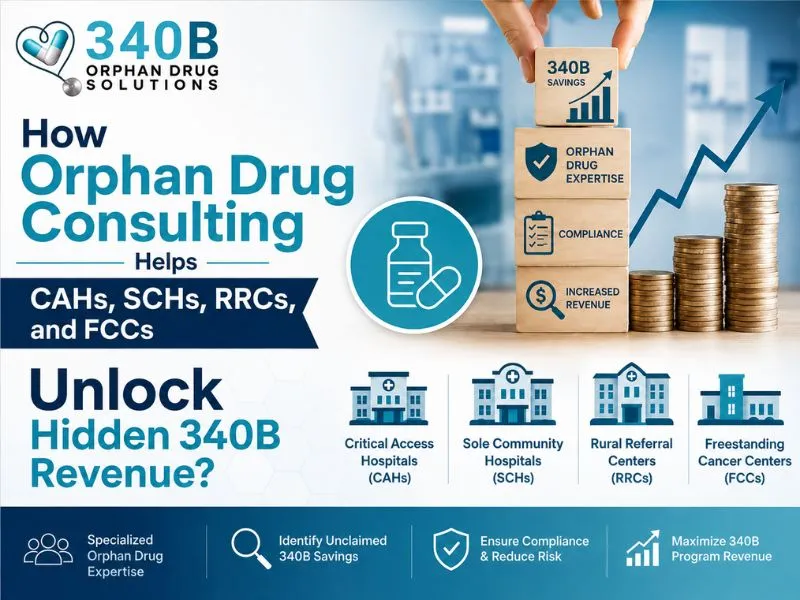
How Orphan Drug Consulting Helps CAHs, SCHs, RRCs, and FCCs Unlock Hidden 340B Revenue?
If you are managing Critical Access Hospitals (CAHs), Sole Community Hospitals (SCHs), Rural Referral Centers (RRCs), or Freestanding Cancer Centers (FCCs) in the rural US, a category of drug might be sitting outside your machinery. We are referring to the US Food and Drug Administration (FDA)- designated orphan drugs.
The 340B Drug Pricing Program governs these drugs. Running a 340B program takes real effort. Your facility needs to have split-billing software and compliance documentation. Also, your healthcare unit must be audit-ready and go for annual recertification. Large hospitals that come under the ambit of Section 340B often manage all of these smoothly. Owing to this, they record a significant financial margin.
Whereas your CAH, SCH, RRC, or FCC might still be sitting on the edge. You must have an efficient administration, but might lack the expertise to leverage the 340B Program. To unlock the hidden revenue, you can always opt for orphan drug consulting.
Problem that Standard 340B Administration Cannot Fix in CAHs, SCHs, RRCs, and FCCs
The 340B Drug Pricing Program was established under Section 340B of the Public Health Service Act. It helps safety-net providers reduce drug costs. Money saved in this process is used to serve underserved patients.
According to the Health Resources and Services Administration (HRSA), participating hospitals use those savings to fund free care for:
Uninsured patients
Mental health services
Rural outreach programs.
When the US Congress expanded the Affordable Care Act eligibility in 2010, it added four new hospital types to the 340B Program as the expansion entities, which are:
Critical Access Hospitals (CAHs)
Sole Community Hospitals (SCHs)
Rural Referral Centers (RRCs)
Freestanding Cancer Centers
During this expansion, Congress amended Section 340B. As per the amendment, under Section 340B(e) of the Public Health Service Act (PHSA), drugs holding an FDA orphan drug designation are excluded from mandatory 340B pricing for expansion entities.
HRSA confirms the orphan drug exclusion list is published quarterly. This list is derived directly from the FDA Office of Orphan Products Development designation records. The four new entities are the new beneficiaries of this exclusion list.
However, disproportionate share hospitals, children's hospitals, and federally qualified health centers are not subject to the exclusion. The restriction applies specifically to the expansion entities added by the ACA.
The financial weight of this exclusion is quite significant.
According to research published in Innovations in Pharmacy, orphan drug purchases represented an average of 44 percent of total annual drug budgets at 18 CAHs in Wisconsin and Minnesota. However, these purchases accounted for only 5% of units purchased. These are high-cost specialty and biologic agents.
Thus, losing mandatory 340B pricing on them is not a marginal gap.
How the 2015 PhRMA v. HHS Ruling Changed the US Healthcare?
On October 14, 2015, the U.S. District Court for the District of Columbia gave a ruling in PhRMA v. HHS. As per the court’s ruling:
Once a drug carries an FDA orphan designation, it is categorically excluded from mandatory 340B pricing at all four expansion entity types.
To exclude an orphan drug from the 340B pricing, for the expanded entities, the indication will not matter. The diagnosis-based pathway to mandatory savings was closed.
Before this landmark judgement, HRSA suggested the exclusion applied only when an orphan drug was dispensed for its designated orphan indication. It also suggested that tracking and documenting non-orphan uses of the same drug could potentially allow hospitals to access mandatory 340B pricing on those purchases.
Perhaps the court ruled the other way.
Furthermore, the ruling did not prohibit manufacturers from voluntarily offering discounted pricing on orphan drugs to expansion entities. That channel remained open. But because the mandatory mechanism was gone, many pharmacy teams concluded there was nothing left to pursue.
With this, the mandatory pricing mechanism changed. However, the revenue opportunity did not change at all. It moved into a channel that requires active effort to access.
Some manufacturers continued to offer voluntary sub-WAC or 340B-like pricing on their orphan-designated products to qualifying entities. This discretionary pricing is offered on manufacturer-set terms, does not flow automatically to any hospital, and must be identified, requested, and integrated into purchasing workflows. That process requires exactly the kind of dedicated, specialized attention that standard 340B program management is not built to provide.
To ensure smooth management, orphan drug consulting becomes necessary for the expansion entities.
What Does Orphan Drug Consulting Cover?
Orphan drug consulting applies to 340B expansion entities. It is a focused advisory practice built around identifying and capturing the discretionary pricing. The discretionary pricing is available after the mandatory ceiling price no longer applies.
A structured consultation addresses the following areas related to orphan drugs:
1. Building a Current, Facility-Specific Orphan Drug List
The FDA grants orphan drug designations on a rolling basis. HRSA updates the orphan drug exclusion list every quarter. Covered entities are required to use that list as the primary compliance reference. A hospital working from a static list built during initial program setup is almost certainly missing drugs added in recent quarters.
Effective orphan drug consulting begins with a case-mix and purchase analysis to identify every orphan-designated drug a facility is currently buying. From there, a facility-specific list is built and maintained with:
Automated quarterly updates aligned to each HRSA orphan drug exclusion list revision
Monthly alerts when newly approved orphan designations affect the portfolio
Biosimilar identification and switching strategy integrated throughout
NDC-level documentation to support compliance and audit readiness
2. Direct Manufacturer Outreach to Secure Discretionary Pricing
The initial step to securing discretionary pricing is identifying orphan drugs. The next step is securing favorable pricing.
This means that each drug manufacturer can decide whether to offer voluntary discounted pricing on its orphan-designated products or not. Also, the manufacturer can decide the terms of the pricing. Furthermore, HRSA itself acknowledges that a manufacturer may choose to offer discounts on orphan drugs to these hospitals, but is under no obligation to do so.
Due to this autonomy, manufacturer participation has shifted meaningfully over time. Due to this positive shift, certain programs have ended, others have continued, and terms vary by drug and by entity type. Thus, you need to establish relationships with drug manufacturers and focus on drug-by-drug outreach to get orphan drugs at a discounted price. Also, you should opt for credit and rebill review for purchases that should have qualified for discounted pricing in prior periods.
As per Becker's Hospital Review, health systems may not be prepared to navigate the 340B complexities related to orphan drug purchasing. This unpreparedness is primarily due to the dynamic FDA drug exclusion list.
3. Split-Billing Software Integration and Purchasing Workflow Configuration
Savings only materialize if the hospital's purchasing workflow routes orphan drug acquisitions through the correct channel. Without proper split-billing software configuration, a hospital can negotiate excellent pricing and lose the savings anyway at the point of purchase.
Well-structured orphan drug consulting addresses this with upload-ready software files. Also, job aids for pharmacy purchasing staff and a credit and rebill feedback loop for purchases that went through the wrong channel should be rectified.
Thus, the software and workflow must be updated each quarter as the orphan drug list and pricing agreements change.
4. Ongoing Expert Support
The orphan drug landscape changes every quarter. A consulting relationship that delivers a report and steps away cannot capture the compounding value of this work.
Therefore, an effective orphan drug consulting includes:
Ongoing manufacturer monitoring
Direct access to a specialist
Continuous communication as pricing programs open, close, or change terms.
Thus, the difference between a static one-time engagement and an active ongoing relationship is the difference between recovering revenue once and maintaining a revenue stream that grows quarter over quarter.
Therefore, consulting goes a long way in generating revenue for CAHs, SCHs, RRCs, and FCCs in the long run.
Why Consulting Belongs Outside the General 340B Program?
A well-run 340B program handles covered outpatient drug eligibility, patient definition, split-billing compliance, and HRSA recertification. General 340B consulting supports those processes. However, orphan drug discretionary pricing falls entirely outside that framework.
Discretionary pricing is not a compliance question. It is a revenue recovery question for your healthcare facility. Thus, you should know:
Which manufacturers currently offer voluntary pricing?
What do you need to do to access drugs at a lower price?
How did the terms of the drug manufacturer change last quarter?
How to configure a facility's workflow to convert those agreements into actual savings?
This can be supported by the HRSA's 2024 program purchase data. As per HRSA, 340B covered entities purchased a total of 81.4 billion dollars in covered outpatient drugs during that year. High-cost specialty drugs were a major part of the total purchase.
As specialty drug volume grows, the gap between what expansion entities capture on mandatory 340B pricing and what they leave on the table in discretionary pricing widens. General 340B programs are not designed to close that gap. Orphan drug consulting is.
What to Expect from an Orphan Drug Consultant?
From a practical standpoint, facilities engaging in dedicated orphan drug consulting should expect:
A baseline analysis identifying orphan drugs currently being purchased outside the discounted channel
A facility-specific orphan drug list that is more complete and current than what the facility maintained independently
Discretionary pricing secured on applicable drugs, with retroactive credit and rebill review where permitted
A purchasing workflow configured to capture savings at the point of acquisition each quarter
Ongoing updates that keep the program current without adding to the pharmacy team's workload
Ready to Find Out What Your Hospital is Missing?
If your CAH, SCH, or RRC has never had a dedicated orphan drug revenue review, there is a high probability that you are under-recovering. You need to know by how much.
340B Orphan Drug Solutions offers a free 30-minute orphan drug revenue assessment exclusively for expansion entities. You will hear exactly what we would look at, what we would likely find, and whether our engagement model is the right fit for your facility.
Email us at [email protected] for consultation.