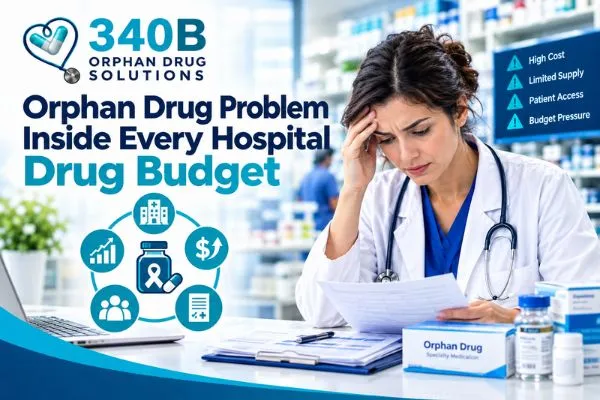
Orphan Drug Problem Inside Every Hospital Drug Budget
If you run pharmacy operations for a rural hospital, you know that it’s not an easy job. The hospital drug budget is an expense line that keeps changing. As per the Centers for Medicare & Medicaid Services (CMS), prescription drug spending in the United States increased 7.9 percent to $467 billion in 2024. CMS projects retail drug spending will continue growing at 5.7 percent per year on average through 2034. This is a challenge for hospitals that are running on thin margins.
The problem is that the source of this challenge is often overlooked. A few costly drugs, most of which are orphan-designated, have been the source of all the issues. For Critical Access Hospitals, Sole Community Hospitals, Rural Referral Centers, and Freestanding Cancer Centers, those drugs come with a 340B complication that most hospital pharmacy budget management frameworks are not set up to handle.
How Specialty and Orphan Drugs Are Reshaping the Hospital Drug Budget
The most important thing to understand about the modern hospital drug budget is how disproportionately it is driven by a small number of high-cost products. National prescription drug spending hit $467 billion in 2024, up from $433 billion in 2023.
Within hospital settings, specialty and biologic drugs are the primary driver of pharmaceutical budget growth year over year. These drugs mostly contain orphan-designated products.
In the 340B program, HRSA's 2024 covered entity purchase data shows the same concentration. Of $81.4 billion in total 340B purchases in 2024, specialty drugs purchased through specialty distribution channels accounted for 61.5 percent of all spending by dollar value despite comprising only 40 percent of units purchased.
That gap between volume share and dollar share is the signature of specialty and orphan drug economics. It is a relatively small number of prescriptions carrying an outsized share of the total hospital medication expense.
Orphan-designated drugs sit at the high-cost end of that spectrum. Medicare spending on sole orphan drugs grew from $3.4 billion in 2012 to $10.0 billion in 2021. Of 368 FDA-approved drugs between 2016 and 2023, 50 percent were orphan drugs. As the pipeline expands, these products represent a growing fraction of what hospitals purchase.
Hospital Pharmacy Budget Management and the 340B Orphan Drug Exclusion
For most 340B covered entities, hospital pharmacy budget management follows a familiar framework. The framework is as follows:
Purchase covered outpatient drugs at 340B ceiling prices
Generate margin on the acquisition-to-reimbursement difference
Use that margin to fund expanded services.
The 340B ceiling price typically produces discounts of 20 to 50 percent compared to market prices. On high-cost drugs, those savings are significant. The framework breaks down into one category: orphan-designated drugs at expansion entities.
Under Section 340B(e) of the Public Health Service Act, drugs holding an FDA orphan drug designation under Section 526 of the FFDCA are excluded from mandatory 340B ceiling pricing for the excluded entities:
Critical Access Hospitals (CAHs)
Sole Community Hospitals (SCHs)
Rural Referral Centers (RRCs)
Freestanding Cancer Centers.
The U.S. District Court for the District of Columbia confirmed in PhRMA v. HHS on October 14, 2015, that this exclusion is categorical. As per the ruling, the designation triggers the exclusion regardless of the clinical indication for which the drug is dispensed.
Standard hospital pharmacy budget management tools, including split-billing software and 340B purchasing accounts, do not automatically resolve this. If anything, they may give pharmacy teams false confidence that orphan drug savings are being captured when they are not.
How Big Is the Gap in Practice
A peer-reviewed study published in Innovations in Pharmacy examined 18 Critical Access Hospitals in Minnesota and Wisconsin and found that orphan drug purchases represented an average of 44 percent of total annual drug budgets at those facilities while accounting for only five percent of units purchased.
The 18 hospitals spent a combined $9.9 million on orphan-designated drugs in a single year. At 340B ceiling prices, those same purchases would have cost $6.8 million. The gap was $3.1 million, roughly $171,000 per hospital per year, that existed because the mandatory discount mechanism did not apply and no alternative pricing had been pursued.
That $171,000 is not a hypothetical. It is a documented, measurable shortfall in hospital drug cost savings that flows directly from the orphan drug exclusion. And it reflects only the difference between what was paid and what the mandatory 340B price would have been. It does not account for the additional opportunity that manufacturer discretionary pricing may have provided had it been actively pursued.
Pharmaceutical Budget Optimization: Why Orphan Drugs Require a Different Approach
Standard pharmaceutical budget optimization covers formulary management, generic substitution, and 340B purchasing compliance. These tools serve the vast majority of hospital drug spend well. They are not the right tools for orphan drug savings at expansion entities, which require a different set of capabilities entirely:
Current orphan drug list maintenance
The FDA Office of Orphan Products Development grants new orphan designations on a rolling basis, and HRSA publishes an updated orphan drug exclusion list every quarter.
A hospital that has not updated its orphan drug list since program setup is making purchasing decisions based on stale data. Drugs added to the FDA designation database since the last review may be excluded from mandatory 340B pricing and purchased at full WAC without the team realizing it.
Manufacturer discretionary pricing engagement
HRSA confirms that a manufacturer may, at its sole discretion, choose to offer voluntary discounted pricing on orphan drugs to expansion entities.
Some manufacturers do. Identifying which ones, on which products, and through which purchasing channels requires active, ongoing manufacturer-by-manufacturer outreach. This is not something a standard hospital pharmacy budget management workflow delivers.
Split-billing software configuration specific to orphan drugs
Even when discretionary pricing has been secured, the savings only materialize if the split-billing system routes those acquisitions through the correct channel. A software configuration that has not been updated to reflect current orphan drug pricing agreements generates no savings at the point of purchase.
Credit and rebill review for past purchases
Purchases that should have qualified for discounted pricing but were not routed correctly can often be recovered through manufacturer credit and rebill processes. This retroactive review is a standard part of orphan drug revenue recovery but rarely happens as part of routine hospital drug budget planning.
None of these capabilities fits neatly inside a pharmacy department's existing workflow. The orphan drug exclusion created a revenue recovery task that standard hospital pharmacy budget management was not designed to deliver.
Hospital Medication Expenses and the Cost of Inaction
Retail drug spending is projected by CMS to grow 5.7 percent per year through 2034.
The number of orphan drug designations continues to expand. The FDA approved approximately 87 orphan drugs per year on average between 2017 and 2021, and that pace has continued.
Every new designation added to the FDA database is a potential addition to the list of drugs excluded from mandatory 340B pricing at expansion entities. For rural hospitals already on thin margins, the orphan drug share of hospital medication expenses will grow, not shrink, and the savings gap that exists today will be larger next year unless it is actively managed.
What the 340B Data Shows About the Opportunity
HRSA's 2024 covered entity purchase data breaks out purchases by entity type. Here are the records:
These are the four entity types subject to the orphan drug exclusion. Their combined 340B purchases were approximately $4.2 billion in 2024. Even a conservative estimate of orphan drug spending as a portion of that total points to hundreds of millions of dollars in annual drug purchases where mandatory 340B pricing does not apply and voluntary pricing may be available but is not being captured.
According to CMS Actuary projections, the growth of hospital expenditure is expected to be 5.2 percent annually through 2034. This is compounded growth. Any hospital drug cost saving potential that is not realized within five years is not just a single year’s forgone savings; it is compounded.
Healthcare Drug Budget Planning That Accounts for Orphan Drugs
Effective healthcare drug budget planning for expansion entities needs to treat the orphan drug portfolio as a distinct category. That means three things, which are as follows:
First, the orphan drug list must be treated as a live document. HRSA updates the exclusion list quarterly from the FDA designation database. Budget planning without such changes creates the basis for inaccurate information about the drugs that should and should not have mandatory 340B pricing.
Second, the process needs to have a realistic estimation of the discretionary pricing of the facility's orphan drug portfolio. That means knowing which manufacturers are actively offering voluntary pricing, on which specific drugs, and at what terms right now. The participation of different manufacturers has changed significantly in recent years. Also, some of the major orphan drug manufacturers stopped their participation in the program.
Third, discretionary pricing needs to be operationally connected to the purchasing workflow. A pricing agreement that is not reflected in the split-billing software configuration generates no savings. Healthcare drug budget planning for orphan drugs has to include the infrastructure to make the numbers real at the point of purchase every quarter.
Your Orphan Drug Budget Gap Has a Number. Let Us Find It.
If your hospital is a Critical Access Hospital, Sole Community Hospital, or Rural Referral Center, the orphan drug portion of your hospital drug budget almost certainly includes savings that are not being captured. The question is not whether the gap exists. The question is how large it is.
340B Orphan Drug Solutions offers a free 30-minute orphan drug revenue assessment for CAHs, SCHs, and RRCs. We will show you exactly which drugs in your portfolio are affected, what voluntary pricing may currently be available, and what a focused engagement would likely recover.