The $1 Million 340B Line Item Nobody Put In Your 2027 Budget
Four things that moved in 340B this month — and why your orphan drug book is the only lever you still control.
On Monday, August 24, drug manufacturers filed their rebate plans with HRSA.
That deadline passed quietly. It shouldn’t have. It was the moment the 340B rebate model stopped being a proposal and started being a date on your calendar.
Here is what moved this month, and what it means if you run a Critical Access Hospital, Sole Community Hospital, Rural Referral Center, or Free-Standing Cancer Center.
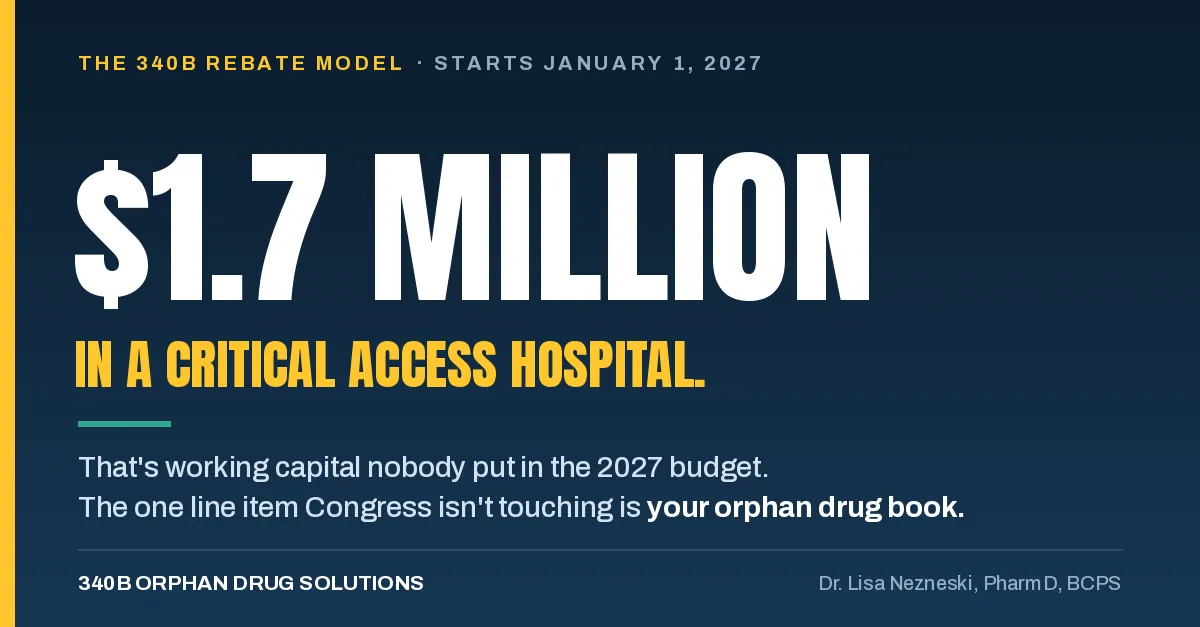
1. Your Rebate Float Is Over $1 Million. In A Critical Access Hospital.
Not a health system. Not an academic medical center. A critical access hospital.
Here are the mechanics, in the only terms that matter to a CFO. Under the rebate model, you no longer buy at the 340B price. You buy at WAC. You dispense. You submit the claim. Then you wait for a manufacturer to send back the difference.
That gap is working capital. Yours. For however long the rebate takes.
Analysis published by 340B Health puts the added cash requirement for a critical access hospital at roughly $1.7 million. For the average 340B hospital, a separate estimate reported through HFMA and produced by VytlOne ranges from $2.34 million to $4.67 million annually — and that estimate covers only the drugs in the first negotiation cycle.
The pilot begins January 1, 2027. HRSA is expected to approve manufacturer plans by September 24, after which approved manufacturers give 90 days’ notice.
Count the quarters. You have one left.
This is the part I want you to sit with. Every advisory published this month tells you to model your cash flow impact before January. Not one of them tells you where the offsetting cash comes from.
That’s the question. Here is the answer.
2. Five Federal Proposals. Not One Of Them Touches Your Orphan Book.
Read them all. The Cassidy discussion draft. The SUSTAIN 340B Act. The HRSA rebate pilot. Every one legislates on covered outpatient drugs.
Under section 340B(e), for Critical Access Hospitals, Sole Community Hospitals, Rural Referral Centers and Free-Standing Cancer Centers, orphan-designated drugs are excluded from that definition.
Sit with what that means.
The most consequential reform in the program’s history is being drafted, litigated, and lobbied over — and it has almost nothing to say about a category of drugs where you may be overpaying six figures a year right now.
Which makes your orphan drug book the only line item on your 340B ledger that isn’t waiting on Congress, a court, or a manufacturer’s discretion.
The float is real. The float is coming. The cash that absorbs it has to come from somewhere, and the fastest place to find it is the drug category nobody is legislating.
Everything else on your list this quarter is outside your control. This one isn’t.
You have one quarter. And two things happened this month that make it tighter than it looks.
3. The DSH Rules Moved Twice In One Month
A federal court vacated the provision that lowered DSH percentages. Days later, a bill landed in the House.
On August 25, Rep. Hillary Scholten introduced legislation that would temporarily protect certain hospitals from losing 340B eligibility when their DSH percentage falls below threshold.
If your SSI percentage has been drifting, both of those developments are now your problem — because the reclassification conversation you were going to have next year just became a conversation you’re having this quarter.
And here is what almost nobody models before they convert: the day your status flips from DSH to Rural Referral Center, the orphan drug exclusion goes live against you.
The high-cost specialty items you have been buying at 340B pricing for years are suddenly full freight. Most hospitals absorb it. They were told orphan drugs don’t apply to them anymore, they believed it, and they never went back and checked.
That one sentence costs rural hospitals six figures a quarter.
I’m teaching the full mechanics of this on September 3. Details at the bottom.
4. Recertification Is Open. One Field On That Form Is Worth Six Figures.
Your Authorizing Official is about to click through a form that sets your orphan drug position for the next twelve months.
The hospital recertification window opened in mid-August. Most people treat it as an administrative chore — verify the addresses, confirm the contacts, submit, forget.
For your four entity types, it is not administrative. It is where you make your orphan drug election, and where your hospital classification, DSH adjustment percentage, and cost report data get locked into OPAIS for the year.
Get one of those wrong and you have created a compliance exposure and a financial one in the same click.
Before your AO submits, verify five things: your hospital classification, your DSH adjustment percentage, your cost report filing date, your orphan drug election, and your Medicaid Exclusion File entries.
Then confirm your close date directly in OPAIS. Don’t rely on the calendar in your head.
One More Date: September 30
Roughly half of orphan drug contracts roll on September 30.
Contracts already rolled once on June 30. If nobody has rebuilt your orphan drug list since then, your list is already wrong — and it is about to get wronger.
This is the failure mode I see most often: the item quietly moves to a GPO-only or PHS-only catalog, nothing in your system flags it, and you keep buying it on the wrong account for three quarters before anyone notices.
Nobody sends a letter when this happens.
If your TPA hasn’t rebuilt your orphan list since June, ask them why.
The Webinar: DSH to RRC — The $200K Question
Thursday, September 3 · 3:00 PM Eastern · Free · Replay included
Sixty minutes on what actually happens to your drug spend when your eligibility changes on paper.
What you’ll walk out with:
The 2015 ruling that rewrote the argument. PhRMA v. HHS, decided October 14, 2015, changed what the orphan drug exclusion means for expansion entities. It is still binding. Most hospitals are operating on the version of the rule that lost.
The DSH-to-RRC transition, line by line — what changes the moment your status flips, and the opportunity most converting hospitals walk straight past.
How one rural hospital found $1.5 million. A real engagement, quarter by quarter. Roughly $18 million in annual drug spend. Twelve-month total: $1,538,896. The final quarter came in 90% above the one before it.
Why your catalog is lying to you in 2026 — and what the September 30 contract roll is about to do to your list.
A 30-day action plan you can hand to your pharmacy team on Friday.
Can’t make 3:00 PM Eastern? Register anyway. The replay arrives cut into three 15-minute segments — the rule, the money, and the moves — so you can watch it between meetings and forward the right piece to the right person.
Part 2 is fifteen minutes and all dollars. That segment exists specifically so you can send it to your CFO.
Registrants also receive full access to the webinar vault, the 340B Orphan Drug Playbook, and 50% off the DSH-to-RRC Recovery Opportunity Assessment.
Register free — September 3 at 3:00 PM ET: -
The hospitals that find this money are not smarter than you.
They just checked.
Dr. Lisa Nezneski, PharmD, BCPS
Founder & CEO, 340B Orphan Drug Solutions
Register for the September 3 webinar ↗